Home Blog Page 256

South Africa needs more skilled tradesmen -Nzimande

SOUTH Africa needs more artisans such as bricklayers, diesel mechanics, instrument technicians, riggers, auto electricians and millwrights.

The department of higher education, science & innovation says there is a high demand for tradesmen who are highly skilled and who primarily work in a technical field, doing skilled manual labour.

Minister Blade Nzimande says the department is working hard to encourage young people to become artisans
“In 2014, we launched the decade of the artisan, which seeks to promote artisanship as a career of choice for SA’s youth and highlights skills development opportunities for artisans.”

Mihle Mvelakubi, 25, from Flagstaff, owns Mvelakubi Civil Engineering and Projects, which does bricklaying, tiling, plumbing and paving.

Mvelakubi says his passion had started when he was a learner at Agulhas School of Skills in Napier in the Western Cape, where he specialised in bricklaying and plastering, woodwork, welding and agriculture.

After school, he chose the technical and vocational education and training (TVET) route, doing an NC (V) civil engineering and building construction level 2-4 programme. He eventually obtained a national diploma in civil engineering and building, after completing his N4 to N6 at the College of Cape Town.

In 2017, he represented SA in bricklaying at the WorldSkills international competition in the UAE.

“The competition helped me realise that bricklaying is not just a trade, but is also an art that I developed through consistent practice, great mentorship and guidance.

“Without skills, we wouldn’t have had any of the things we have, such as buildings, cars, planes and trains.

For the economy to grow, we need all these skills and critical thinking. It is the TVET institutions that create these skilled people
“For the economy to grow, we need all these skills and critical thinking. It is the TVET institutions that create these skilled people,” said Mvelakubi.

To enter a recognised learning programme to become an artisan, you must get at least 40% for mathematics (excluding maths literacy) and a grade 9 or national certificate level 2 pass.

You will need to attend a TVET college and then do workplace learning before being able to take a trade test, which will certify you as a qualified artisan.

Trade tests can be done at a national trade test centre which is accredited by the Quality Council for Trades and Occupations.

This article first appeared in GCIS Vuk’uzenzele.

IEB Releases Final Matric Exam Timetable For 2022

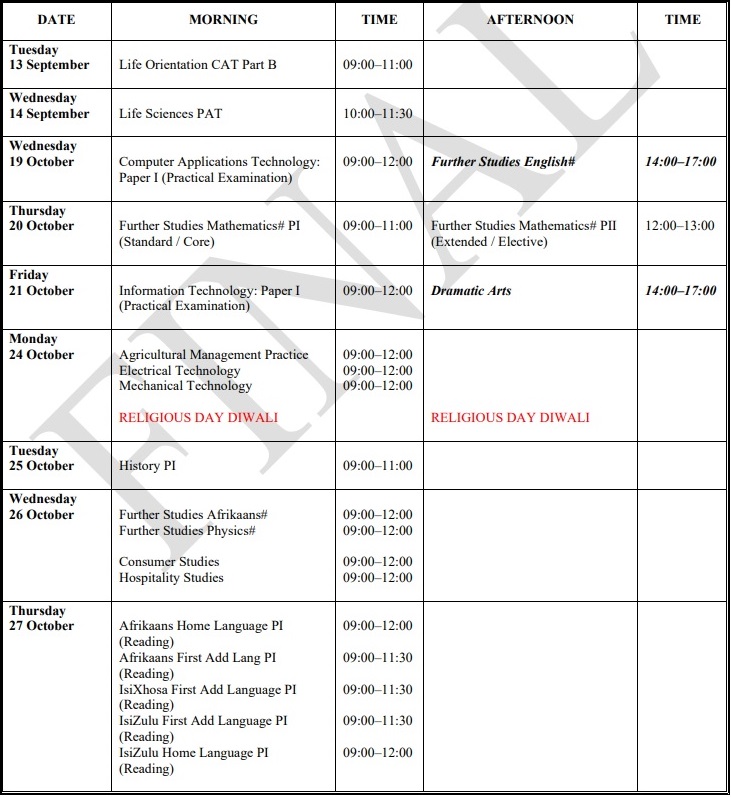
THE Independent Examination Board (IEB) have released their final National Senior Certificate (NSC) examination timetable.

The IEB is a private assessment board that offers examination services to private or client schools. They are also accredited by Umalasi, the same quality assurance body that approves NSC examinations that normal public school learners in South Africa participate in.

IEB schools achieved a 98.39% pass rate in the 2021 NSC examinations.

This was slightly higher than the 2020 pass rate of 98.06%. Their matric class of 2021 consisted of 12 857 full-time and 968 part-time candidates.

Here’s The 2022 IEB Final Matric Timetable

IEB matric exam timetable 1
IEB matric exam timetable page 2
IEB matric exam timetable page 3
IEB matric exam timetable page 4

Winter school camp to promote careers in built environment sector – DPWI

THE Department of Public Works and Infrastructure is this week hosting the 8th annual Winter School Camp programme.

The purpose of the winter school is to promote careers within the built environment sector and create a solid foundation for a high pass rate in Mathematics and Physical Science. 

This aims to enable learner’s access into careers within the built environment, while prioritising the attendance of learners from disadvantaged communities and females.

“The camp forms part of the department’s mandate to transform the built environment sector by providing support to educators through enrichment programmes that help teachers become better Mathematical and Physical Science educators,” the Department of Public Works and Infrastructure said in a statement. 

The camp will have interactive exhibitions and expose the learners to career opportunities in the built environment sector while addressing the challenge of scarcity in educational resources that lead to poor performance in schools.

Since the programs’ inception in 2013, 42 schools have participated, while there are 22 schools currently enrolled this year, with 48 learners participating.

The prerequisites for learners to participate are:

-Each school needs to have an average of 40% of their Grade 10 – 12 scholars doing Mathematics and Physical Science and for Grade 9 – 12, and for

-learners to achieve a minimum of 60% for Mathematics and Physical Science.

Young ed-tech founder equips learners with digital skills

IVOR PRICE  

INSPIRED by his grandparents, South Africa entrepreneur Shivad Singh founded Head Start Education, an online platform providing digital educational material for teachers and learners, when he was only 19.

Singh, who hails from KwaZulu-Natal, launched his business, formerly known as Presto, after graduating with a Bachelor of Commerce degree at the University of Cape Town. His aim is to equip learners and teachers with essential digital skills that will lead to an improvement in their overall skills development and employability.

Head Start Education serves as a gateway to Africa for educators to promote the advancement of education across the continent. The company is a reputable ed-tech provider, holding exclusive licenses for over 20 educational products world-wide. They supply these products to schools and large corporates that are then able to provide these services to their teachers, learners or customers.

“The focus for our business is to help learners leave high school with a quality education,” says Singh.

“The education sector in Africa and other developing countries continues to face serious challenges with poor quality of resources, irrelevant curriculums, poor learning outcomes and lack of infrastructure. These challenges have led to 1.2 million learners in South Africa entering Grade 1 with less than half of them completing high school.”

E-school platform on Head Start

Head Start has a “Netflix for Education” e-school platform that aggregates over 1 000 videos and affordable PDF content for their customers. The content is relevant to the school syllabus, and promotes financial education, entrepreneurship, coding, personal growth and emotional well-wellbeing.

Singh has received various forms of support to ensure the success of his business. Notably, he has received business skills training, mentorship and access to finance through his entrepreneurial journey with the SAB Foundation, one of the leading South African organisations in the social innovation space.

He started his journey with the foundation when he was selected for the University Seed fund. He was then announced as a winner at the SAB Foundation Social Innovation Awards and is now receiving support from the SAB Foundation Social Innovation Fund.

Through the support of my mentor provided by the SAB Foundation, we closed our first big deal,” he explains. “We also signed an agreement with an established financial institution and partnered with a leading school franchise in South Africa.”

According to Singh, the biggest highlight on his journey has been launching his Mobi Class education platform with the cellular provider, MTN.

With this support, he has provided educational content to over 300 000 learners. Originally Singh was running the business on his own, but this has grown and he now has five employees. His annual turnover has increased to almost R1 million per annum.

In 2017, Singh was recognised as a News24 Young Mandela of the Future, and received the “Leading South African Award” by One Young World. He is also the youngest member of South Africa’s Tai- Chi demo team.

Apart from running a global business, Singh still taps into his inner child and engages in digital social media platforms like TikTok. His passion and drive for entrepreneurship was inspired by his grandfather, Benny Singh.

“My grandparent’s life journeys are my inspiration,” shares Singh. “My grandfather lived in a one bedroom flat and couldn’t afford to go to university. However through sheer grit and determination, he made a success as an entrepreneur.”

Singh was further inspired by his great grandfather, who was the first South African Indian to pass high school in 1925, and the first person of colour to become principal of Sastri College in Durban. 

“I see myself as a combination of these two great men,” he said.

“My message to other entrepreneurs is to always be on the lookout for training and skills development opportunities,” added Singh. 

“It is vital that you have these tools in order to establish and grow a sustainable and successful business.”

Founded in 2010, the SAB Foundation provides grant funding for small, medium and micro-sized enterprises in order to contribute to the economic and social empowerment of historically disadvantaged persons through entrepreneurship development. More than R425 million to date has been invested in social innovation, disability empowerment and SMMEs.

Ventureburn 

KwaZulu-Natal has over 2 800 unqualified teachers in the classroom

THE provincial education department in KwaZulu-Natal has revealed that the number of unqualified teachers in classrooms has increased from 215 to 2,810 by May 2022.

This is according to parliamentary questions to the department.

The department revealed that in February 2020 it had only 215 unqualified teachers, a more than tenfold increase to 2810 by May 2022.

KZN Education’s response also revealed that the areas most affected in terms of unqualified teachers are:
• Zululand has 357 unqualified educators
• King Cetshwayo with 325
• UThukela 281
• Umgungundlovu 270 and;
• Pinetown 267.

The department said it was providing bursaries to the teachers to get their qualifications within the next five years.
If the qualification was not obtained within this period, the teachers would be replaced with qualified teachers.

According to KZN’s Democratic Alliance (DA), Education MEC, Kwazi Mshengu, in his February 2020 parliamentary reply, all unqualified teachers have been given 30 days notice from March 1 and will be reinstated by qualified teachers replaced by educators.

The DA said said grades still mattered as part of the overall educational process, and one of the biggest problems at the foundation stage was the inability to read meaningfully and a lack of fundamentals when it came to subjects such as maths.

“While these are not taught in grade R, this year forms the basis for developing cognitive skills for the following school year.”

The DA also questioned why unqualified R-rated teachers were hired when there was no shortage of qualified teachers at home.

“It is incomprehensible that the DOE chooses to keep ineligible individuals on its payroll while qualified teachers struggle with unemployment after years of study and debt,” the DA said.

INSIDE EDUCATION

Curro eSports launches new South African gaming platform with Acer

INDEPENDENT school group Curro Holdings, in partnership with Acer for Education, has launched Curro’s own eSports gaming platform in South Africa.

Utilising help and expert guidance from Acer, Curro’s innovative new platform reassures parents with an extra layer of cyber security to ensure learners’ safety while playing online video game tournaments as part of the school group’s pioneering eSports programme.

Curro’s eSports programme has already registered more than 1,900 learners from across 38 of the group’s primary and 28 of the group’s high schools since its launch in 2020.

Until now, learners playing any of the tournaments, including Apex Legends and Minecraft Squad, as well as traditional eSports games like Rocket League, have not had a central space to view information. However, the new Acer platform allows teams to view their rankings but also makes it possible for coaches to manage players, coordinate tournaments and also allow communication between players as well as between players and coaches.

The tournaments are live-streamed via Twitch which means everyone gets to watch.

“We are amazed at how quickly our eSports programme has taken off. Our parents now understand that eSports is not just about playing video games as an extracurricular activity, but in fact, provides an entire world of opportunity for our learners, as an integrated part of our curriculum,” says Angela Schaerer, Digital Transformation Manager at Curro Holdings.

Schaerer says the new platform allows them to take their eSports offering to a whole new level of learning and upskill their learners and staff even more.

“For example, they can now shout cast (MC) games on the platform which is an extremely exciting opportunity, and we are already working closely with Acer to introduce a shout casting mentorship programme soon. We are planning to host our inter-Curro Cup tournament later this year, to determine the best eSport school in the group,” Schaerer says.

Recent research has identified numerous benefits to playing eSports and video games. These include improving the players’ ability to process and prioritise information, and enhancing their critical and creative thinking skills while quickening decision-making and reaction time without sacrificing accuracy.

Regular gaming also helps learners develop self-confidence and calmness, as well as acquire 21st-century skills like social awareness, collaboration, adaptability, persistence, and resourcefulness. These competencies could have ongoing future returns, helping learners secure valuable careers, especially in areas of math, science, and engineering.

Curro says it has been forging ahead with its eSports programme after witnessing the popularity of virtual sports during the Covid-19 lockdown when traditional sports were prohibited. Since then, the independent education provider has quickly fostered a name for itself in the global eSports community, having claimed victory in an International Minecraft match against a school in California in June 2021.

ITNEWS

Morocco Absent from Ranking of Best Cities for Study Abroad

0

THE recent QS Best Student Cities 2023 ranking did not include any Moroccan city.

The ranking, issued by Quacquarelli Symonds (QS), lists the world’s best cities for studying abroad, taking into consideration numerous factors including desirability, affordability, and the opinions of current students.

This year’s ranking investigated 110 cities, 58 of which improved their positioning while 46 dropped in their global ranking.

In Africa, Cape Town topped the regional ranking with an overall score of 56.1 out of 100; the South African city ranked 78th worldwide.

Cairo and Johannesburg were the only other two African cities to feature on the list, with a respective overall score of roughly 50 out of 100 and a worldwide ranking of 94th and 97th.

For the Middle East region, the Emirati cities of Dubai and Abu Dhabi provided the best conditions for studying abroad, ranking 51st and 71st worldwide. Abu Dhabi tied with Daejeon, South Korea’s fifth-largest city.

Saudi Arabia’s Riyadh came 99th in the global ranking and third in the ME ahead of the Jordanian cities of Amman (113th) and Ibrid (139th).

As the Middle Eastern cities had to compete against each other for a leading position, the QS put them under the Asia region, placing them against South Korea’s capital.

Seoul notably aced the regional and global ranking as it has proven to be the second-best student city in the world in a tie with Munich, Germany.

The two cities scored 95.1 out of 100 in the QS ranking. Munich outshined the Korean capital this year in the student voice indicator which measures the student experience in a city.

Meanwhile, Seoul received a perfect score in the index measuring the number of “outstanding institutions” hosted by a city.

Still, London dominated the ranking for another year with “exceptional scores” for student mix at 94.9 and desirability at 94.9.

England’s capital also provides a “high concentration of world-class universities [which] also helped boost its position, achieving the world’s second-best score in the Rankings Indicator,” QS said.

Commenting on London’s performance as a student city, Ben Sowter, QS Senior VP, said the city “offers outstanding cultural, economic, and educational opportunities.”

He continued, “With two of the world’s ten best universities situated in the city, it remains a world-leading educational hub.”

But London’s increasingly high cost of living is raising concerns about whether the city would remain a favorable destination for students. This phenomenon extends to other major educational hubs.

“Worryingly, cities are broadly becoming less affordable for students by QS’ measures, with just under 90% declining in our Affordability metric,” Ben concluded.

MOROCCO WORLD NEWS

OPINION| Are internships the way to address unemployment?

WE close Youth Month on a sad note. Twenty-one young people lost their lives at Enyobeni Tavern in East London. Events like this remind us how at-risk our young people are, often from themselves.

The unbridled war of our times, the need to keep a watch and help especially young people in the times we are living in. The outlook is not so good, despite the rallying cry for intensifying concerted efforts to assist young people.

The latest Quarterly Labour Force Survey from Statistics South Africa shows an increase in youth unemployment. So unstable is the situation that oscillations are evident. For instance, in the Eastern Cape, where I am based, figures from the Eastern Cape Socio-Economic Consultative Council Quarterly Labour Force Survey reveal a noted decrease to 45% in terms of the unemployment rate in the province.

Yet the national tally in terms of the youth unemployment rate is soaring. Among the youth cohort from ages 25 to 34, over 40% are unemployed.

Concerning is the 63.9% unemployment rate for those cohort aged 25 and 34. At the summit of this age group are the products of higher education institutions in graduates at 32.6%. All this is described as our job bloodbath.

One noted effort in addressing the youth unemployment challenge is the use of internship programmes.

The idea here is to get youth into sectors where skills gaps are evident to increase their employability through work experience. Such sectors where human capital could be required include the public service, often gaining notoriety as blotted and inefficient.

On paper, internships, especially those targeting youth, may appear noble and with well-intended aims to address the youth unemployment challenge.

Yet in reality, the efficacy of such efforts could potentially be taking us nowhere quickly. This appears to be the admission from the government. Internships may potentially increase the unemployment pool.

In the past 18 months, I have been collecting data, especially with young people who have been working in internship programmes run within different public service entities.

These range from business functional areas such as human resources, supply chain, information technology, logistics, and agricultural management services. These young people join over 43 000 of their counterparts in internship programmes offered by the government nationally.

So what is working in youth internship programmes?

A starting point here is an appreciation of being in some form of employment. The idea of waking up in the morning and being part of the workforce is appreciated.

For some of the youths in our sample, the internship programme was the first window to learn about the world of work. Accompanying this is the development of a repertoire of soft skills. These skills included time management, problem-solving, teamwork and leadership insight.

Such skills become helpful in enhancing the intern’s portfolio, including subsequent employability.

For some young people, the internship experience offered gainful employment. A capability argued within the positive psychology literature where the intern is a recipient of work and payment for self-sufficiency.

Coupled with this, interns in our study prioritised the need and desire to be able to assist the immediate family financially through their meagre earnings. Such a situation was a means of an ephemeral existential contribution, albeit the lack of permanency and uncertainty that comes with internships.

Yet amid the success stories, a murky morass complicates things, potentially making internships a modern-day exploitative experience.

Further, internships may exist as a masquerade in our efforts to address the skills challenge. The rigid labour market system potentially stalls our progress.

The ominous challenges are plenteous. First, there is the challenge of getting into the internship programme. An experience often reduced to the probability of who you know. Mention was made of middle men often requiring a service charge to guarantee one a place on the internship programme. For many young people, applying for such internship programmes is a substantial emotional and financial investment.

Potentially this reduces a programme meant to assist often marginalised young people to be elitist in nature. This opens up some to be exploited. Some of our participants even narrated sordid experiences of requests for sexual favour to guarantee a position as an intern. The price one pays to attain skills.

Second, interns are often exploited in the same internship experiences they are taking part in. Their voices muttered platitudes such as “you are fortunate to have some form of work, be grateful”.

So being lucky to at least have an internship experience amid the soaring unemployment rate becomes a proxy to silence youth voices in exploitative work environments.

Third, interns are also often exploited in terms of the work they are engaged in. Usually, this includes doing all the hard, routine and mundane work. Some of this work is not necessarily related to the intern’s job description.

Our attention should be two-fold in nature.

First, from a national government perspective, let us re-visit the very efficacy of internship programmes in addressing the youth unemployment challenge.

Could rogue behaviours in the system potentially be destroying our efforts of skills acquisition? On the altar should be an honest critique of the current provincial and national programmes in assisting young people.

Second, there is also a need to address ground challenges around the intern as a critical organisational actor.

Interns should be getting skills and needed work experience and not being sent to buy lunch for the office.

Advocacy is necessary here, especially for interns. The priority should be on promoting decent work conditions for interns despite them not having a permanent workplace status. The lack of such a status should not relegate interns to exploitation.

If all work is noble, we need to continually introspect in enhancing the internship experience (or re-think if we really need such efforts). For the greater good of the country, there is no substitute for quality.

Chinyamurindi is a professor at the University of Fort Hare and head of the Department of Business Management. He writes in his personal capacity.

New school subjects planned for South Africa

THE Department of Arts and Culture plans to formally introduce more cultural subjects to the school curriculum as a way of encouraging interest and development in the sector.

The proposals are included in a new Theatre and Dance policy document which was gazetted for public comment on Friday (1 July). While drama has formed a key role at South African schools for decades, it is hoped that the formal introduction of new subjects and curriculums will lead to more job pathways in the sector.

“Dance and theatre are to be integrated into the curriculum at primary and secondary school levels both for vocational purposes and in order for learners to benefit from the cognitive, creative and problem-solving skills that engagement in the arts enhances,” the department said.

“There must be at least one publicly-funded tertiary education and training institution/department teaching theatre and dance, in each province that provides certificate, diploma and undergraduate courses for practitioners as well as educators, producers, technicians, designers, administrators and entrepreneurs in the dance and theatre sector.”

Other proposals in the document include:

  • All tertiary institutions that provide training for dance and theatre practitioners, must include in their training an arts administration/management foundation module that covers areas such as cultural policy, entrepreneurship (marketing, raising capital, financial management, budgeting, etc) and the rights of artists.
  • Monitoring the implementation of Arts Education curriculum in all schools and grades to ensure that such education is delivered by qualified arts practitioners,
  • Each year, a minimum of ten administrators/entrepreneurs under the age of 35 be identified through an open, competitive process, with at least 50% being women; that they be placed with ten of the country’s leading arts administrators for at least a twelvemonth period to be mentored by them, to acquire hands-on experience, with both the mentors and mentees being paid stipends.
  • Through open and competitive processes, at least ten directors and ten choreographers be identified annually, and be provided with stipends to work with, and/or observe the country’s established directors, playwrights and choreographers over a 12-month period.
  • Playwriting courses be offered in each province annually, with selected writers – particularly those under 35 – in each province being mentored by an experienced playwright (remotely over email and zoom-type technology if necessary).
  • Annually, technical training courses with a number of people proportionate to provincial populations being trained in the technical aspects of theatre and dance production, and being provided with opportunities to acquire practical experience at the country’s festivals and theatres.
  • Annual online and physical courses for arts critics (including dance and theatre critics) be offered, with mentors working with selected new critics over a year-long period.

Other subjects

The Department of Basic Education has already announced that it plans to introduce several new school subjects to the curriculum in the coming year.

In its 2022/2023 annual performance plan published in March, the department said this will include full-scale implementation of coding and robotics for Grade R-3 and 7 in the 2023 academic year.

A pilot curriculum for these subjects was initially introduced at some schools in the third term of the 2021 academic year, it said. It plans to expand these tech-focused subjects to other grades in subsequent years.

“The coding and robotics pilot for Grades 4-6 and for Grades 8 is planned for 2022 and will be followed by a Grade 9 pilot in 2023. The full-scale implementation for Grades 4-6 and Grade 8 is planned for 2024, and Grade 9 in 2025,” the department said.

“As coding and robotics is a new initiative, the focus will be on the upskilling of teachers to be trained to teach this new subject in collaboration with higher education institutions.”

The department said that the new subjects form part of a broader push to better prepare South African students for the working world.

“Future careers require people with digital skills that will equip and enable them to function effectively in a digital era. The continued implementation on the teaching of coding and robotics will equip and expose learners to digital literacy, virtual reality, augmented reality, machine learning, artificial intelligence and the Internet of Things,” it said.

“The sector notes that the future requires individuals who will be able to build robots and other sophisticated machines and to develop algorithms to code these machines.”

BUSINESS TECH

‘Our nation mourns the young lives lost in Enyobeni Tavern tragedy’ – Ramaphosa

CYRIL RAMAPHOSA|

Just over a week ago, in the early hours of a Sunday morning, families in the township of Scenery Park outside East London, received news that every parent prays they never get to hear.   

They were told that 21 of their children had been found dead, in a tavern. The youngest child was only 13 years old.

The police investigation into the tragedy is proceeding apace. Flowing from the investigations, the Buffalo City Metro is looking into whether the tavern violated any municipal regulations.

As we prepare to lay these young people to rest this week, our thoughts and prayers are with the families who are struggling to come to terms with this unspeakable horror.

We commend the Eastern Cape provincial government for assisting the affected families, as well as AVBOB that has pledged to assist the families with the burials. 

Even as the relevant authorities deconstruct what happened to ensure there is justice for the victims, there is a conversation we do need to have as a country. It is the problem of under-age drinking.

The footage and images posted online of the so-called ‘pens down’ party at the venue that night show revelling youngsters clutching bottles of alcohol. Many of those in the images look barely out of their teens.

A number of young people from Scenery Park have told the media of having seen a post circulated on social media, offering free rounds of alcohol to all who attended the event that night.

The increased social acceptability of young people drinking alcohol has become a serious problem in a country where the majority of the drinking population are already classified by the World Health Organization as binge drinkers.

Alcohol use amongst adolescents is associated with impaired function, absenteeism from learning, alcohol-related injuries, suicidal thoughts and attempts, and risky behaviour.

We must come together to combat this vice that is robbing our young people of the best years of their lives, and making them susceptible to alcohol addiction.

As families it means having open and frank conversations about alcohol and setting boundaries. Children under the age of 18 consuming alcohol is against the law.

As adults we should refrain from practices such as sending minors to buy alcohol for us or capitulating to requests to buy these young people alcohol.

It is not the first time we have been confronted with tragic events such as what happened in Scenery Park last week.

A common denominator between Enyobeni tavern, the Throb nightclub disaster in Durban in 2000, and the Osi’s tavern tragedy in Khayelitsha in 2015, is that these establishments were selling liquor to minors.

The proliferation of establishments openly flouting the law points to failings on the part of authorities to enforce regulations.

Under the National Liquor Act, owners of establishments with liquor licenses may not sell alcohol to anyone under the age of 18. They must also take reasonable steps to ensure anyone they are selling alcohol to is of age.

We call on communities to work with authorities to ensure that taverns, shebeens, entertainment venues and outlets breaking the law face the consequences.

We call upon our police to step up the enforcement of laws that prohibit the sale of alcohol close to schools and enhance monitoring of outlets to ensure alcohol is not being sold to minors.

Another reality is that alcohol is a form of escapism for young people in communities were opportunities for safe and age-appropriate recreation are few.

The Scenery Park community has pointed to the lack of sports, learning and other developmental facilities for young people, leading them to resort to ‘tavern hopping’.

In the wake of the tragedy, the community has pointed out that there are no viable sports grounds, community libraries or youth centers in Scenery Park.

As government at national, provincial and local level we need to respond to the pleas of this community and those of other communities by developing more recreational spaces, facilities, programmes, and projects for our young people in disadvantaged areas in the province.

Other social partners such as the business community should also assist with sponsorship.

As communities we must work with our Community Policing Forums, with our civics organizations and with our school governing bodies and play a more active role in the lives of our children and in ensuring their safety and well-being.

As they say in our African indigenous classics “it takes a community to raise a child”.

Let us work together to protect our precious future generation from the ravages of alcohol and drug abuse and their effects.

Let us work together to ensure that those who put profit before the lives of our children are not allowed to operate.

Let us also set a positive example in our own relationship with alcohol.

Let us be keepers of not just our own children, but our neighbours’ children as well.

From the desk of the President