Home Blog Page 26

Fossil hunters find a new dinosaur track site on South Africa’s coast – the youngest so far

By Charles Helm and Willo Stear

Southern Africa is world renowned for its fossil record of creatures that lived in the very distant past, including dinosaurs.

But, about 182 million years ago, a huge eruption of lava covered much of the landscape (the inland Karoo Basin) where most of the dinosaurs roamed. After that, the dinosaur fossil record in the region goes abruptly quiet for the Jurassic Period (which lasted from 201 million to 145 million years ago).

Two exciting recent discoveries confirm, however, that there is more to find of dinosaurs that lived in southern Africa a long time after those lava flows.

First, dinosaur tracks aged around 140 million years were reported in 2025 on a remote stretch of the coast in South Africa’s Western Cape province. These were the first to be found in the region from that geological time period (the Cretaceous, 145 million to 66 million years ago).

Now, we’ve found more.

Our work as a team of ichnologists (studying fossil tracks and traces) often takes us to the Knysna area of the Western Cape coast, where we investigate tracks in coastal aeolianites (cemented sand dunes) in the age range of 50,000 to 400,000 years old.

During one of these visits, early in 2025, we decided to visit a small patch of rock that formed during the early Cretaceous Period. It’s the only place in the vicinity where rock of this age is exposed, and much of it is underwater at high tide. We thought we might be lucky enough to find a theropod (dinosaur) tooth like the one discovered in those rocks by a 13-year-old boy in 2017.

We were pleasantly surprised when instead Linda Helm, a member of our party, told us in a state of excitement that she had found dinosaur tracks. Further examination of the deposits revealed more than two dozen probable tracks.

Shoreline seen from above
The Brenton Formation exposure. Charles Helm, Author provided (no reuse)

This so-called Brenton Formation exposure is tiny, no more than 40 metres in length and five metres in width, with cliffs rising from the shore to a maximum of five metres. To find dozens of tracks in this small area suggests a considerable dinosaur presence in the region during the Cretaceous.

In our study we estimate that these tracks are 132 million years old, making them the youngest known dinosaur tracks in southern Africa (50 million years younger than the youngest tracks reported from the Karoo Basin). They form the second record of dinosaur tracks from the South African Cretaceous, and the second record from the Western Cape province. Some of them occur on rock surfaces, while others occur in the cliffs in profile.

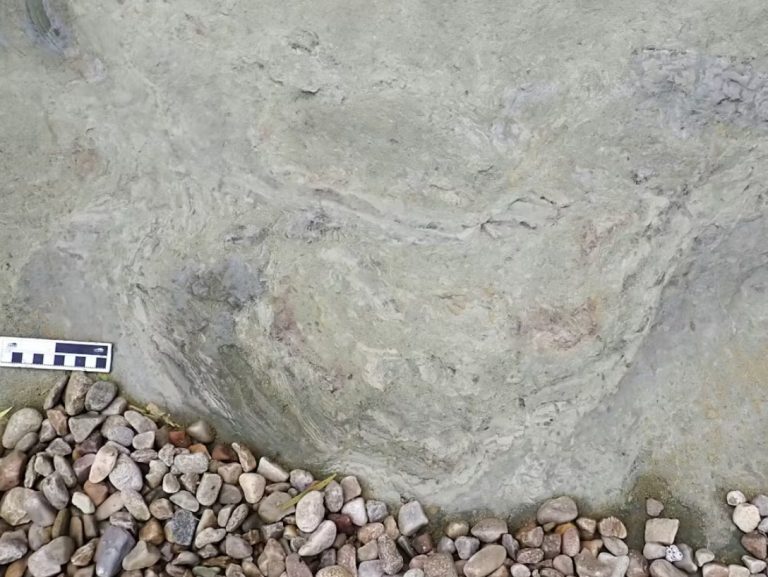
Rocky surface with faint outline of three toes
Theropod track, seen ‘three-quarters-on’ – the three narrow toes can be seen above the 10cm scale bar. Charles Helm, Author provided (no reuse)

Dinosaur fossil treasures

Southern Africa has a wealth of vertebrate tracks and traces from the Mesozoic Era (the “Age of Dinosaurs”, from 252 million to 66 million years ago, a time span that includes the Jurassic) in the Karoo Basin – a vast inland basin filled with thick piles of sedimentary deposits.

Dinosaur tracks from the Triassic and Jurassic periods are abundant in Lesotho and surrounding areas in South Africa’s Free State and Eastern Cape provinces.

But vast quantities of lava, now referred to as the Drakensberg Group, overlaid these track-bearing deposits as a result of large-scale eruptions. A few dinosaurs appear to have briefly survived the initial effects of the lava flows, and were probably among the last vertebrates to inhabit the Karoo Basin.

Then, as the supercontinent of Gondwana fragmented at the end of the Jurassic Period and in the early Cretaceous Period, limited Cretaceous terrestrial deposits formed in rift basins in what are now the Western Cape and Eastern Cape provinces of South Africa.

Dinosaur body fossils have been reported from those deposits, mostly from the Eastern Cape. They include the first dinosaur to be identified in the southern hemisphere, now identified as a stegosaur, as well as sauropods, a coelurosaurian and iguanodontid hatchlings and juveniles.

The only examples of dinosaur skeletal material from the Western Cape are a few isolated sauropod teeth, disarticulated bones of a probable sauropod, and two cases from the Knysna area: the theropod tooth mentioned above and a portion of a tibia.

But now we’re after their tracks.

Three-toed footprint
This theropod track has been lightly outlined in white chalk; scale bars = 10 cm. Charles Helm, Author provided (no reuse)

Dinosaurs of Knysna

The tracks we found at Knysna are in the modern intertidal zone, where the high tide covers most of them twice a day.

It would be difficult to imagine a more different scene, 132 million years ago, than the spectacular coastline, magnificent estuary, and lots of development by humans that we encounter today. Back in the early Cretaceous, many dinosaurs would have been visible in the area, perhaps inhabiting tidal channels or point bars (river beaches). The vegetation would also have been very different from that of today.

The Brenton Formation tracks were made by theropods, possibly ornithopods (both these kinds of dinosaur were bipedal, walking on two legs), and possibly sauropods (huge dinosaurs with very long necks and very long tails that were quadrupedal, walking on four legs). Theropods were meat eaters, while ornithopods and sauropods were plant eaters.

It can be challenging at times to distinguish theropod tracks from ornithopod tracks. Sauropod tracks are larger and don’t always have clear digit impressions, also sometimes making them hard to identify with confidence.

In most cases, we have chosen not to “over-interpret” which types of dinosaurs made which tracks, as they just aren’t clear enough. Our research paper simply intends to document that dinosaur tracks of this age are relatively plentiful in the Brenton Formation.

The fact that early Cretaceous dinosaur tracks have now been identified in both the Robberg Formation and the Brenton Formation suggests that more may be found if a search is conducted in appropriate places.

There are a number of other exposures of non-marine Cretaceous rocks in the Western Cape and Eastern Cape. Systematic exploration of these deposits is now indicated, in the hope that in addition to finding more dinosaur skeletal material, more dinosaur tracks (and potentially those of other vertebrates) will be identified.

Chris Helm is Research Associate, African Centre for Coastal Palaeoscience, Nelson Mandela University.

Willo Stear is Research Associate, African Centre for Coastal Palaeoscience, Nelson Mandela University.

Mark G. Dixon and Fred van Berkel of the African Centre for Coastal Palaeoscience, Nelson Mandela University, contributed to this research.

This article was first published by The Conversation.

INSIDE EDUCATION

KZN school gets six chemical toilets in ‘PR exercise’ after years-long wait for basic infrastructure

By Lebone Rodah Mosima 

It has taken six years for the KwaZulu-Natal Department of Education (KZNDOE) to address sanitation challenges affecting over 1 000 pupils at Mthiyaqhwa High School, located in the Madiyane area of Nkandla, within the King Cetshwayo District.

Classes were suspended at the school last week after an inspection by the district municipality’s environment and health services found the sanitation and structural conditions at the school were non-compliant and not fit for children or adults.

The school’s principal, Zulu Zwelabo, told Inside Education that the school has an enrolment of 1 016 learners but received only six chemical toilets on Thursday as a temporary measure, following what he said were about six years of delays in addressing basic infrastructure needs.

“This is far below the department’s own norms and standards on infrastructure. At the height of Covid-19, a commitment was made to deliver decent sanitation facilities,” Zwelabo said.

“The contractor was appointed and didn’t complete everything, not even a single one.”

Zwelabo said the school still has asbestos classrooms despite long-standing decisions to remove them, and faces an infrastructure backlog that includes crumbling walls.

More needed to be done than the current “PR exercise”, he said.

A classroom at the school. (Photo supplied)

The KZNDOE said on Friday that its district infrastructure team held engagements with the Independent Development Trust (IDT), and that an “immediate intervention was implemented to ensure that teaching and learning are not disrupted” at the school.

The IDT delivers social infrastructure and social development programme management services on behalf of government.

The department said it had provided chemical toilets and prioritised basic sanitation needs “without delay”.

“The IDT confirmed its commitment to deliver the chemical toilets by the morning of 29 January 2026,” the department said.

“We confirm that the chemical toilets have since been delivered to Mthiyaqhwa High School, ensuring that learners and educators have access to adequate sanitation facilities while longer-term infrastructure solutions are being addressed.”

Zwelabo said the department only responded after the school received the emergency health risk notice ordering it to suspend operations until alternative sanitation arrangements were made.

The KZNDOE did not respond to questions about the cost of the toilets or other terms of the contract.

INSIDE EDUCATION

Water Research Commission and UKZN launch partnership to boost water, sanitation innovation

By Levy Masiteng 

The Water Research Commission (WRC) and the University of KwaZulu-Natal (UKZN) will on Monday launch a five-year partnership aimed at strengthening research and innovation in water, sanitation and hygiene.

This as South Africa faces growing pressure on water and sanitation systems from climate change, rapid urbanisation and infrastructure constraints.

The partnership, implemented by UKZN’s Water, Sanitation and Hygiene Research and Development Centre (WASH R&D Centre), will focus on developing and scaling solutions including water-efficient sanitation systems, non-sewered sanitation technologies, wastewater reuse and circular economy approaches.

The emphasis will be on improving service delivery in underserved communities.

“This partnership strengthens the link between science, innovation and implementation. By positioning the UKZN WASH R&D Centre as a strategic extension of the WRC’s research ecosystem, we are deliberately investing in solutions that can be validated, derisked and scaled to support South Africa’s sanitation and water security goals,” WRC Chief Executive Officer Dr Jennifer Molwantwa said.

The WRC said it has committed a substantial amount of funding over five years, with co-funding from UKZN, to support initiatives including postgraduate training, curriculum development for short courses, capacity building for practitioners and municipalities, innovation extension services, and joint knowledge dissemination activities. The partnership will be overseen by a Joint Steering Committee comprising representatives from both institutions.

“The WASH R&D Centre embodies UKZN’s vision of engaged scholarship. Through this partnership with the WRC, we are strengthening our ability to generate practical, policy-relevant solutions while training the next generation of water and sanitation professionals for South Africa, the continent and the world,” said Professor Anil Chuturgoon, UKZN’s Deputy Vice-Chancellor for Research and Innovation.

UKZN said its WASH R&D Centre — formerly known as the Pollution Research Group — has a track record in sanitation technology testing, decentralised wastewater systems, faecal sludge management and socio-technical research, supporting evidence-based policy, regulatory development and adoption of innovative sanitation technologies by municipalities and industry.

The institutions said the partnership aligns with national priorities including the National Development Plan and Sustainable Development Goal 6, which aims to ensure the availability and sustainable management of water and sanitation for all, by 2030.

INSIDE EDUCATION

DUT ranked among top 6% of higher education institutions worldwide

0

By Lebone Rodah Mosima 


The Durban University of Technology (DUT)  has been ranked among the top 6% of Higher Education Institutions (HEIs) worldwide for the second year in a row, as it continues to strengthen its global profile in the 2026 Webometrics Ranking of World Universities.

Earlier this week, Alan Khan, Senior Director of Corporate Affairs at DUT, said the latest ranking evaluated more than 32000 HEIs globally, positioning DUT within a select group of universities recognised for digital visibility, research excellence and commitment to open access knowledge. 

ALSO READ: Next wave of infrastructure investment must include people, not only platforms

DUT has climbed 1039 positions in the latest Webometrics global university ranking over the past year, advancing from 2855th place in 2024 to 1816th in 2025.

“In South Africa, the ranking included 124 institutions, among them all 26 public universities, reflecting a highly competitive national higher education environment,” Khan said. 

Khan said DUT was previously ranked in the same top 6% of universities worldwide in 2025, as South Africa’s leading University of Technology, sustaining academic and digital performance.

Since 2004, the Webometrics Ranking of World Universities has been published by the Consejo Superior de Investigaciones Científicas (CSIC), the largest public research organisation in Spain. 

“Unlike many global rankings that primarily focus on long-established, globally recognised universities, Webometrics evaluates a broad spectrum of institutions, including those in the Global South that are often overlooked,” Khan said. 

ALSO READManamela urges shift from university-only mindset

“The ranking aims to promote open access to knowledge produced by universities and places emphasis on the quantity and quality of higher education web content.”

According to Webometrics, Khan said the rankings influence academic behaviour and institutional direction, and noted that “one of the most powerful tools for initiating and consolidating change in academia, increasing scholars’ engagement, and establishing long-term strategies.”

Professor Fulufhelo Nemavhola, Deputy Vice-Chancellor: Research, Innovation and Engagement at DUT, welcomed the achievement and said the results reflect the university’s sustained focus on impactful and accessible scholarship. 

“This recognition affirms DUT’s commitment to producing high-quality, socially responsive, impactful research that is visible, accessible and relevant beyond our institutional boundaries,” Nemavhola said. 

Nemavhola said that the Webometrics 2026 ranking has highlighted the collective efforts of the university’s academic community. 

ALSO READ: WATCH: McKenzie unveils new sports facility at Heidedal Primary School

“Being placed in the top 6% globally, out of more than 32000 institutions, is a significant milestone,” he said 

“In line with our ENVISION2030 strategy, it speaks to our growing research excellence, our digital maturity and our determination to contribute knowledge that makes a meaningful difference to society.”

INSIDE EDUCATION

DA and Gauteng Education Department clash over alleged 64% school budget cut

0


By Levy Masiteng

The Democratic Alliance (DA) and the Gauteng Department of Education (GDE) are at loggerheads over claims of a drastic 64% reduction in operational budgets for Quintile 5 schools, due to take effect from 1 April.

The DA has accused the department of slashing funding in a way that will “devastate schools, teachers and learners.”

ALSO READ: Next wave of infrastructure investment must include people, not only platforms

The GDE, however, has dismissed the allegations as “false, misleading, and reckless.”

Gauteng DA spokesperson for education, Michael Waters, said the department’s denial “is a lie” and contradicts its own official responses in the Gauteng Provincial Legislature (GPL).

“The GDE’s claim that it has not cut Quintile 5 school budgets by 64% is hollow and misleading,” Waters argued.

He added that “no government facing a budget shortfall should ever consider cutting funding to schools. It is unjust, unfair, and ultimately the coward’s way out. Instead of taking difficult decisions to rein in waste and non‑core spending, the ANC‑led Gauteng government has chosen the softest and most vulnerable target – children.”

The GDE insists that what is being implemented is not a cut but an interim funding realignment, prompted by severe budget reductions imposed by the National Treasury across all provinces.

ALSO READManamela urges shift from university-only mindset

According to the department, the adjusted funding levels for Quintile 5 schools are aligned with the national norms and standards for school funding set by the Department of Basic Education (DBE).

“This process does not constitute a budget cut, but rather a realignment to nationally prescribed adequacy rates, particularly correcting the historical funding of certain Quintile 5 fee‑paying schools,” the GDE said.

The department added that schools were notified as early as September last year through indicative budget allocation certificates, providing what it described as “ample notice and transparency.”

Gauteng Education MEC Matome Chiloane acknowledged the province is grappling with a R444 million shortfall in the current financial year and a projected R160 million shortfall over the 2026 Medium‑Term Expenditure Framework (MTEF).

“This is a temporary stabilisation intervention designed to keep the system functional and compliant while managing severe financial constraints,” Chiloane said.

“Despite these constraints, the GDE has prioritised the protection of classrooms, ensured teaching and learning continue uninterrupted, and honoured its Learning and Teaching Support Material payments in full and on time.”

Chiloane also argued that if petitions are to be delivered, they should be directed to the Department of Basic Education, which is responsible for national funding norms and allocations.

ALSO READ: WATCH: McKenzie unveils new sports facility at Heidedal Primary School

Waters rejected the department’s terminology.

“This is not a ‘realignment’. It is not a ‘stabilisation intervention’. It is a cut and a devastating one at the expense of schools, teachers, and learners.”

The DA has launched a public petition calling for the reversal of the alleged cuts. As of Saturday, the petition had gathered 5,241 signatures, with 24,759 more needed to reach its target of 30,000 supporters.

INSIDE EDUCATION

BOSA says TVET colleges need boost to support excluded youth

0

By Levy Masiteng 

Build One South Africa (BOSA) has challenged the government to change the narrative around post-school education, saying that university isn’t the only path to success. 

The party said tens of thousands of young people will this week face the harsh reality that a matric Bachelor’s pass does not guarantee access to university, exposing a system that is increasingly unable to absorb the growing number of school leavers.

ALSO READ: Khumalo tells ad hoc committee ‘misinformation campaign’ targeted Crime Intelligence reforms

“University cannot, and should not, be treated as the only legitimate route to success,” said BOSA spokesperson Roger Solomons in a media statement.

“The enormous mismatch between matric passes and spaces at universities highlights a post-school system that is failing young South Africans.” 

According to Solomons, each year more learners exit the schooling system with Bachelor-level passes — a trend partly driven by declining matric standards, he said — while the number of available undergraduate spaces at public universities remains limited. 

The result, the party warns, is a swelling pool of qualified but excluded young people left without clear or credible alternatives.

ALSO READ: Thabo Bester joins Cat Matlala in Kokstad’s fortress prison eBongweni Super Maximum Correctional Centre

BOSA said that the crisis exposes a broader failure to properly develop Technical and Vocational Education and Training (TVET) colleges as a viable and respected alternative to university education.

“A modern economy requires artisans, technicians, technologists, digital skills and mid-level professionals,” Solomons said. 

Despite this reality, BOSA said, TVET colleges are underfunded, undervalued, and poorly aligned with labour market needs, leaving many qualified students without a clear post-school pathway.

Solomons said he had submitted a series of Parliamentary questions to the Minister of Higher Education and Training, Buti Manamela, about the issues.

In his statement, Solomons said the party is seeking clarity on whether government accepts that TVET colleges must be strengthened to absorb the growing number of students who cannot access university, and what concrete plans exist to make this happen.

“This includes funding, infrastructure, lecturer capacity, curriculum relevance and public confidence in TVET qualifications,” he said.

ALSO READ: Khumalo tells ad hoc committee ‘misinformation campaign’ targeted Crime Intelligence reforms

Solomons said BOSA also wanted Manamela to disclose the annual throughput and dropout rates at TVET colleges, nationally and per institution, the full transparency on the National Student Financial Aid Scheme (NSFAS), including its budget over the past five years, how many students have been funded, how funds were distributed, and the extent of outstanding student loan debt. 

Additionally, BOSA asked whether government plans to expand post-school capacity through new universities or colleges and if not, why such expansion is not being pursued despite rising demand. 

Last week, during a briefing on the state of readiness for the 2026 academic year, Manamela himself said that an entrenched “university-only” mindset was deepening frustration and distorting public debate about tertiary education access.

“The narrative that the only option after matric is university is creating a sense of crisis,” Manamela said.

INSIDE EDUCATION

Foreign learners make up 1.8% of South Africa’s public school enrolment, DBE says

0

By Charmaine Ndlela

Foreign learners make up only 1.8% of South Africa’s total learner population, the Department of Basic Education (DBE) said on Thursday, rejecting claims that children from other countries are “overrunning” local schools as misleading and unsupported by national enrolment data.

“Such assertions are patently false and are not supported by any credible evidence,” the department said in a statement.

ALSO READ: Next wave of infrastructure investment must include people, not only platforms

The DBE said its verified national enrolment data showed foreign learners accounted for a small minority of children in the system, while 98.2% of learners enrolled in public schools were South African citizens.

It said the 1.8% figure included children of ambassadors, diplomatic missions, United Nations agencies and other international organisations who are lawfully present in the country.

“The claim that foreign learners are placing undue pressure on the education system is therefore statistically incorrect, misleading, and irresponsible,” the statement said.

The department acknowledged frustration among parents in high-demand areas who are waiting for school placements, saying national and provincial education authorities were finalising placements and making progress.

ALSO READManamela urges shift from university-only mindset

It cited KwaZulu-Natal as an example, saying the province had placed 100% of applications, while other provinces continued to make progress.

Recent protests outside Addington Primary School in Durban have highlighted how placement backlogs and misinformation about admissions can spill into schools, disrupting classes and drawing a heavy police presence. KwaZulu-Natal’s education department has said the demonstrations were driven by claims that foreign children were being prioritised over South Africans, a narrative the department and MEC Sipho Hlomuka have publicly rejected.

In its statement, the DBE warned against scapegoating and political opportunism around education.

“Any attempt to use the education sector as a platform for scapegoating, social division, or political opportunism must be unequivocally rejected, as a deliberate attempt to sow division and cause unwarranted harm to otherwise peaceful relations within communities and schools, and most importantly, to the wellbeing, dignity, and safety of all children,” it said.

“South Africa’s Constitution and education legislation are unequivocal: every child within our borders has the right to basic education, irrespective of nationality or documentation status,” it said.

ALSO READ: WATCH: McKenzie unveils new sports facility at Heidedal Primary School

The DBE also rejected calls for schools to act as de facto immigration officials. “Schools and educators are not responsible for immigration enforcement,” it said, adding that border control and immigration management were functions of national authorities, not school principals or education officials.

INSIDE EDUCATION

Schools must not be used for social conflict, says Hlomuka at Addington Primary School

0

Staff Reporter

KwaZulu-Natal education MEC Sipho Hlomuka said on Thursday that schools should not be misused to stir community tensions, as he addressed parents and officials at Addington Primary School in Durban, following days of protests outside the institution.

Hlomuka said he was “deeply concerned” by the ongoing protests at the perimeter of the school “that have adversely affected teaching and learning”.

ALSO READ: Next wave of infrastructure investment must include people, not only platforms

“I know that this issue has occupied the heart and minds of South Africa and it has attracted global attention,” Hlomuka said.

“We have a responsibility as the Department of Education to protect everyone who enters our schools, therefore we will not allow schools to be misused as sites of social conflict. Schools exist for one purpose: teaching and learning.”

ALSO READManamela urges shift from university-only mindset

The school – situated on Durban’s popular South Beach – has been the scene of tense, sometimes violent demonstrations this month amid allegation that pupils from immigrant families are being favoured over South Africans for placement.

Some of the admission demands are from indigent families displaced by the April 2022 floods who were moved into temporary accommodation near the school. Those parents have said that transporting their children to other schools will entail crippling financial costs.

Activists from the anti-immigrant movement March and March have been leading protests at the gates of the school, trying to regulate who enters, often with taunts and swearing.
Hlomuka said the protests had left staff and pupils “in trauma”.

“The Constitution of the Republic of South Africa is unambiguous: every child within our borders has the right to basic education.

“Violence has no place in our schools, and those who seek to divide communities by using learners as scapegoats are undermining the values of dignity, equality, and social cohesion,” he said.

He said allegations that the principal and most staff at the school were foreign nationals was false.

ALSO READ: WATCH: McKenzie unveils new sports facility at Heidedal Primary School

Addington Primary had provided enrolment figures showing 1,548 pupils in total, including 968 South African learners and 580 foreign-national learners, he said.

“As things stand there is a list of between 15 to 21 learners that needs to be resolved,” he said.
“We have therefore resolved to take extraordinary measures to assist these learners and their parents. We want to stress however that this is not going to be allowed to be the norm…”

He said 11 Grade R children could not be accommodated at Addington Primary and that the department had arranged for a nearby early-childhood development centre that feeds into Grade 1, to take those learners.

INSIDE EDUCATION

SIU claws back R1.7bn for NSFAS as state tightens grip on student funding abuse

0

By Thapelo Molefe

More than R1.7 billion meant for poor and working class students has been returned to the National Student Financial Aid Scheme (NSFAS) after an investigation exposed years of weak controls, unclaimed funds and payments to unqualified beneficiaries.

The Special Investigating Unit on Tuesday announced it had recovered the money from universities, TVET colleges, parents and former students.

ALSO READ: Former Eastern Cape teacher who murdered colleagues used to randomly shoot gun outside school  

The R1.7 billion forms part of just over R2 billion the SIU has recovered so far in relation to unallocated NSFAS funds between 2016 and 2021.

These were funds set aside for qualifying students who later deregistered or moved institutions but were never returned to NSFAS, despite rules requiring institutions to release the money after one year.

According to the SIU, the failure to recover the funds was largely due to “inadequate control systems and a lack of reconciliation processes” within NSFAS during that period.

“The SIU has returned R1.7 billion to NSFAS’s coffers, which will be allocated to students’ needs at institutions of higher education,” the unit said in a statement.

“These funds represent public resources that must benefit deserving students.”

ALSO READ: March and March vows to continue disruptions at Addington Primary School until local children are placed

A significant portion of the recovered amount came from higher education institutions.

The University of the Witwatersrand paid back R450 million, the University of Pretoria R400 million, and the University of the Free State over R500 million across two payments.

The University of Fort Hare returned R277.6 million, while TVET colleges including Majuba, Motheo and Tshwane North collectively repaid tens of millions of rand.

The SIU has also recovered more than R126 million from 1,055 parents and unqualified NSFAS beneficiaries who signed acknowledgements of debt and agreed to repay the money over time. The unit has urged other unqualified beneficiaries to come forward voluntarily.

The SIU welcomed NSFAS’s move to implement its recommendations, including a new data driven reporting framework and monthly occupancy and payment reports.

NSFAS is also considering bringing payment functions in-house to improve accountability and eliminate intermediaries.

Higher Education and Training Minister Buti Manamela described the recovery as a turning point for student funding governance.

ALSO READ: DBE kicks off national teacher training workshops in Mpumalanga

“The recovery of these funds is a significant step in restoring integrity, accountability and public confidence in the administration of student financial aid,” Manamela said.

“Every rand allocated to NSFAS is public money intended to support students from poor and working class families, and it must be protected and used strictly for that purpose.”

Manamela reaffirmed his support for the SIU’s mandate to investigate corruption, fraud and maladministration across post school education and training institutions.

INSIDE EDUCATION

Gauteng education lays school funding crisis at DA-led national department’s door

Thapelo Molefe

The ANC-led Gauteng Department of Education has shifted the blame for school funding pressures to the DA-led national Department of Basic Education, accusing it of failing to provide relief while allowing what it called misinformation about provincial budget cuts to spread.

The unusually direct attack came as the department rejected claims that it had cut funding to Quintile 5 schools by 64%, saying the allegations were false and deliberately misleading.

Gauteng Education MEC Matome Chiloane said the province was being unfairly scapegoated for implementing national funding norms under severe financial constraints imposed by National Treasury and overseen by the national department.

“It is dishonest to accuse provinces of cutting school funding while remaining silent about the national budget cuts imposed by National Treasury,” Chiloane said in a statement this week. 

“The Department of Basic Education, under the leadership of the Democratic Alliance, is fully aware of the financial challenges confronting Gauteng and other provinces, yet these challenges remain unresolved.”

The department said no 64% funding cut had been implemented and stressed that an interim funding realignment process, effective from 1 April, was being misrepresented as a reduction. 

The realignment aligns funding for certain Quintile 5 fee-paying schools with the National Norms and Standards for School Funding gazetted by the Department of Basic Education.

Schools were formally notified of the adjusted allocations in September 2025 through indicative budget certificates, the department said, arguing that the process was transparent and long communicated.

“This is not a budget cut but a correction of historical funding anomalies in some Quintile 5 schools,” the department said.

The GDE said it is grappling with a R444 million shortfall in the current financial year and a projected R160 million shortfall over the 2026 Medium-Term Expenditure Framework period, pressures it attributes directly to national budget decisions.

Despite this, the department said it has protected classrooms and ensured continuity in teaching and learning.

“We have honoured Learning and Teaching Support Material payments in full and on time, and teaching and learning have continued uninterrupted,” the department said.

Chiloane accused the DA of political opportunism, saying the party was manufacturing outrage while ignoring its role in national policy and funding decisions.

“The sudden outrage being manufactured by the DA is disingenuous,” he said. 

“Provinces cannot be blamed for implementing national policy under constrained budgets we do not control.”

He added that any petitions or protests over school funding should be directed at the national department.

“If there is a petition to be delivered, it should be delivered to the Department of Basic Education, which is responsible for national funding norms and allocations and which the DA itself leads,” Chiloane said.

The department warned that continued misinformation risks undermining confidence in the public schooling system and said the real issue remains the need for sustainable national funding solutions for education.

INSIDE EDUCATION