Home Blog Page 486

Zimbabwe: St John’s deputy head resigns after revealing he is gay

0

Leroy Dzenga

Following a week of fierce debate and a lawsuit threat to the school caused by the disclosure of his sexual orientation to pupils at an assembly, St John’s College deputy head (sixth form) Dr Neal Hovelmeier yesterday resigned from his post.

The educator, who last week revealed that he was gay in a bid to pre-empt a newspaper article, released an apologetic statement announcing his departure.

“I have to fully accept that I had no idea of the force of anger and resentment such a declaration would make, but I would like it known that I am a man who has the utmost respect for people who hold strong views along the lines of custom, tradition, religion and other values.

“I am deeply apologetic for any distress I have caused and the manner in which I acted on Friday. I ask for forgiveness and understanding for the magnitude of this insult,” said Hovelmeier.

Hovelmeier, who had been with the affluent boys’ college dubbed “The Green Blazer” for a decade-and-a-half, claimed he was living in danger since he made his sexual orientation known.

“In the past few days, I have unfortunately come under vitriolic attack from various quarters. I have been in receipt of death threats as well as threats of physical danger to myself and my pets,” he said.

On Monday, there was a parents’ meeting at the school to discuss the issue and it was resolved that further independent investigations be made, but Hovelmeier decided not to wait for the outcome.

“It has also been made clear to me that certain stakeholders are not prepared under any circumstances to have me remain in my position at St John’s to the extent that they have launched legal challenges, made ultimatums and vowed under any and all circumstances to see me dismissed, even by means of intimidation and the manufacture of fabricated evidence against me to see me face a wrath of spurious allegations,” Dr Hovelmeier said.

He added: “For my own sense of integrity, I will not submit myself to a sham trial or investigation to these individuals, the outcome of which would have already been determined regardless of actual circumstance.”

The drama tutor said staying in his position had become difficult in the face of backlash.

“It is for this reason, and with a very heavy heart, that I have come to realise that my current position as deputy headmaster is now untenable and I hereby tender my resignation with immediate effect,” he said.

The school’s trust chairman, Charles Msipa, confirmed receiving communication on Hovelmeier’s resignation yesterday through email.

“I am out of town at the moment, but I can confirm that the school sent an e-mail informing us of Hovelmeier’s resignation. I have not yet spoken to anyone directly with regards to the issue, but I can confirm that the school communicated his resignation to us,” Msipa said.

Conservative parents at the school got their way after demanding the tutor’s resignation. They have also called on the headmaster Cav Trinci to relinquish his position for backing Hovelmeier.

The Herald.

The importance of knowledge and transfer of knowledge and skills in Rwanda

0
Eden Kironde

The sixteenth edition of Africa’s Pulse released in October last year returned quite unfavourable economic results of the African region.

The biannual appraisal of African economies conducted by World Bank observes that whilst Sub-Sahara Africa boasts of the youngest population in the world and its associated positives including poverty reduction and increased shared prosperity, there are several hurdles in the way of this economic prospect.

Chief among the hurdles are the damning skill levels of Africa’s workforce, the lowest in the world as per the report.

This does not reflect the efforts by the respective governments given an average sevenfold increase over the last three decades in public expenditure on education sector geared towards building skills.

Although in Rwanda more staff are trained and equipped for their respective jobs, there is still some room for improvement.

According to the Rwanda Labour Force Survey Report of February 2018, approximately 70.5 of the employed population are reported to be employees, paid apprentices or interns.

However, of this percentage, only 6.3% are professionals and 1% as technician and associated professionals.

Rwanda Development Board (RDB) empowers the youth through several institutional, grassroots initiatives as part of a broad nationwide institutional infrastructure responsible for developing and supporting the growth of entrepreneurial SMEs.

The objective of the initiative, that mainly targets fresh graduates, is to improve the employability of the youth by providing them with skills working directly with small businesses.

Whilst governments play the leading role to arrest the declining trend of skill levels of the overall workforce, the private sector is not without a part to play.

Among a few East African private sector players that have taken the initiative to grow the region’s skill-base is FBW, an established architectural and engineering building consultancy operating across the region.

Paul Semanda the Country Manager FBW- Rwanda reveals that transfer of technological knowledge is a professional responsibility and forms part of the company’s legacy beyond the projects it undertakes.

“It is part of our Human Resource mandate to share technology and the highest possible standards with the people involved on all the projects we undertake. Talented people are our most precious asset.

We are very active in nurturing the development of young professionals throughout the region.”

FBW Group has taken an active and demonstrable role training and educating in East Africa and Europe. Key members of the company management team including Paul Moores – Group Managing Director, Nigel Tilling – Group Projects Director, and Antje Eckoldt – Group Director and Kenya Country Manager; are part of the external review panels of various East African Universities, developing local capacity and transferring their technical knowledge and skills to university students. Joseph Debuni the Director of Engineering at FBW Uganda has been a guest mentor at University of Rwanda.

An in-house intern program provides university students 3 to 12 months of work experience during which time period they hold active roles and responsibilities experiencing all aspects of FBW.

An in-house Continued Professional Development program also enhances the development of its staff and gives international staff a chance to share their experiences. A flexible working plan for its mid tier and junior staff allows staff to get exposed to different work environments and also makes for stronger training.

Semanda is eulogistic in his assessment of the various programs; “The impact of our internal development programmes has been immense,” he says.

“As the company has grown, they have led to a reduction in expatriate staff and increased responsibilities of local staff at management level with great success. Today almost ten percent of all architects practicing in Uganda have trained with us at some stage of their professional journey.”

One of the most recent results of FBW’s drive to share knowledge has seen one of its staff accepted into the Chartered Institute of Architectural Technologist (CIAT), the first person to attain the honour in Africa.

FBW also works in collaboration with the Rwanda Institute of Architects (RIA) and Institution of Engineers, Rwanda (IER) platforms that have enabled the company to further their goal of increasing the local skill-base.

For Sub-Sahara Africa to turn the tables, like the Africa’s Pulse report acknowledges, “sweeping structural reforms that can help ensure that economic growth is anchored on a strong footing” will be required on a continental level across all sectors.

Given the magnitude of the challenge, FBW’s efforts to contribute to the development of the young professionals they interact with may not cause more than a ripple in the East African region, later on the continent, but are wonderfully indicative of the importance of the role the private sector can play to bridge the skills-gap.


Melania Trump to promote child welfare in Ghana, Malawi, Kenya, Egypt

0

Associated Press

Melania Trump plans to emphasise child welfare in Ghana, Malawi, Kenya and Egypt in October on her first extended solo international mission. The trip will also be the first ever to the vast African continent by America’s Slovenia-born first lady.

She discussed the trip on Wednesday at a reception for the spouses of foreign leaders and others participating in the annual UN General Assembly.

“October 1 will mark the first day of my solo visit to four beautiful and very different countries in Africa,” Mrs Trump said during brief remarks to several dozen guests attending the event near the UN headquarters.

She said she looks forward to spreading the message of her “Be Best” child-welfare initiative. She launched the campaign in May to focus on overall child well-being, with an emphasis on opioid addiction and online behavior.

The countries on her itinerary work closely with the US Agency for International Development, which is helping organise the trip, she said.

“Whether it is education, drug addiction, hunger, online safety or bullying, poverty or disease, it is too often children who are hit first, and hardest, across the globe,” Mrs Trump said.

“Each of us hails from a country with its own unique challenges, but I know in my heart we are united by our commitment to raising the next generation to be happy, healthy and morally responsible adults.”

She offered no details on her activities in each country during the trip, which spans the first week of October.

The first ladies of Ghana, Malawi and Kenya attended the event and Mrs Trump recognised each one individually. The first lady of Kenya accompanied President Uhuru Kenyatta to the White House in August and she and Mrs Trump met separately from their spouses.

Mark Green, chief of the international development agency, said its maternal and child health programs have helped save the lives of 4.6 million children worldwide, most of them in sub-Saharan Africa. The agency also works on increasing young people’s access to education. He said African primary school enrollment rates increased from 61% to 79% between 2000 and 2014.

“That excites the recovering teacher in me very, very much,” quipped Green, who spoke before Mrs. Trump. Green was a volunteer teacher in Kenya before he was elected to represent Wisconsin in the House and served as US ambassador to Tanzania.

Mrs Trump will travel next week without President Donald Trump, who raised ire across Africa this year after his private complaint about the continent’s “s-hole countries” was leaked to journalists.

Trump later offered a partial denial in public but privately defended his remarks, The Associated Press reported in January. Trump also didn’t deny the comment when he was asked about it while hosting Nigerian President Muhammadu Buhari at the White House in April.

Aggressive campaigning

The president further roiled South Africa by subsequently claiming on Twitter that the nation is seizing farms and that high numbers of its farmers are being killed, after he saw a Fox News segment about land issues there. While killings of farmers have been taking place for more than 20 years and are widely seen as part of South Africa’s high crime rate, experts say white farmers have not been the target. Nor are there signs of widespread killings.

Trump said earlier on Wednesday that he and his wife “love Africa”.

While the first lady is carrying out her goodwill mission, the president is expected to be in the midst of aggressive campaigning for November elections in which his Republican Party’s control of both houses of Congress is at stake.

Her only other solo international foray was a September 2017 day trip to Toronto to join Britain’s Prince Harry at an athletic competition he founded for wounded service members and veterans, a constituency both the president and Mrs Trump say they value.

She has accompanied Trump to Saudi Arabia, Israel, Turkey, Brussels, France, Japan, South Korea, the United Kingdom and Finland for a July summit with Russian President Vladimir Putin. She did not travel with him to Singapore in June for a similar meeting with North Korean leader Kim Jong Un due to medical restrictions on her travel following kidney surgery in mid-May.


Coding lessons in a day’s work for all

Siyabonga Kalipa

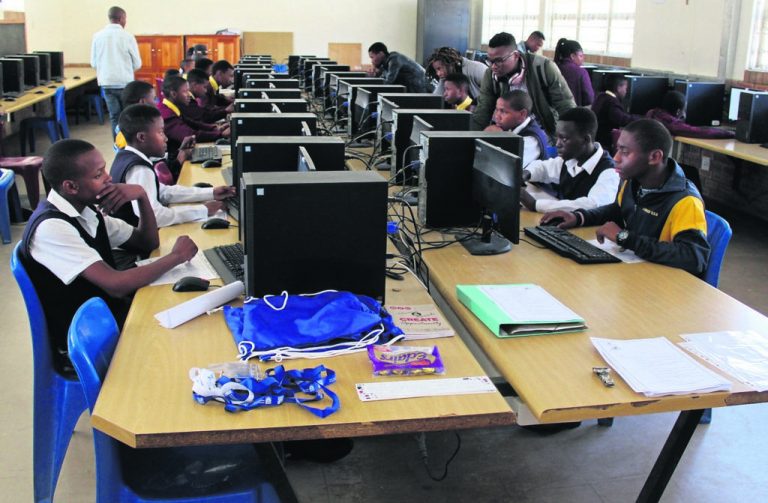
Grade 9 learners from schools around Khayelitsha were given some computer skills in a programming workshop held at Luhlaza High School on Saturday.

The learners were given coding lessons, life skills and interacted with invited speakers.

The workshop was run by AmaQawe ngeMfundo, the AfrikaCan Foundation and the Thope Foundation, all non-governmental- organisation(NGOs) .

Dr Fanelwa Ajayi of AmaQawe ngeMfundo said the workshop is to introduce programming to Grade 9 learners.

She said the emphasis was on coding with the goal of encouraging the learners to choose Pure Maths in Grade 10.

“We intend to use coding activities in order to stimulate interest in Science, Technology, Engineering and Mathematics because these activities are planned to show the importance of Pure Maths in Programming and Coding,” she said.

AfrikaCan foundation’s Athenkosi Nzala said it is always good to give back to their communities, which was what they were doing with the workshop.

“We believe that for black people it is always a need to give back, especially in education and it is nice for children to see successful black people,” he said.

He said they are making available platforms that learners do not necessarily get in their schools and they also want to give hope.

Olwethu Tshingo,14, form Luhlaza High School, said the workshop really helped because he left with a lot of knowledge about coding and life skills.

“I learnt about programming and also the language used when dealing with computers,” he said. Mihle Feleza,15, from Bulumko High, said he now knows what to do in order to become an engineer.

“Attending the workshop was really helpful and hopes it will not be the last one.”

News24

Namibia: Public libraries target 100% access to ICT by 2022

0

Albertina Nakale

The Directorate of Namibia Library and Archives Service in the Ministry of Education, Arts and Culture, targets for all public libraries to have access to computers and internet by the year 2022.

Namibia Library and Archives Service manages a network of 65 public libraries, of which 60 are currently offering free access to computers, and 57 are providing free access to internet in their communities.

Its director, Sarah Negumbo, noted that one of the aims of the ministry of education is to ensure public access to Information and Communication Technology (ICT) in all public libraries.

“Public libraries in Namibia are shifting away from the traditional book lending services, to offering different kinds of services, which focuses on community needs, including technology-based information and training services,” she said.

The directorate also announced a new partnership agreement with Electronic Information for Libraries, aimed to strengthen the continuous professional development of librarians at public libraries across the country.

“The partnership agreement with Electronic Information for Libraries has surely arrived at the right time, as it will assist us to capacitate our staff members, to be able to render better services to the library users,” Negumbo said.

She revealed the partnership project commenced as of August this year to April 2020, with the aim of empowering a group of Namibia Library and Archives Service librarians to become trainers, so that they can provide ongoing training within the network of public libraries in Namibia.

During this period, the Namibia Library and Archives Service and Electronic Information for Libraries jointly will assess training needs of the librarians in the library and archives service network.

It will also train a group of 17 trainers who upon completion of the training, will continuously train public librarians in the network and develop a plan for continuous capacity building of Namibia’s public library network.

The trainers will learn generic training skills and knowledge in specific topics, including developing and introducing new technology-based services, re-organising library spaces, change management, using technology to improve existing information services, conducting of library impact studies as well as communications and advocacy.

After the training and mentoring programme conducted by the team, the trainers will begin training other librarians. Negumbo noted the Namibia Library and Archives Service plans to develop a Master Plan for continuous staff training, which will be integrated into the ministry’s Human Resources Development Strategy by the end of the project.

“This is the Electronic Information for Libraries’ first major capacity building activity in Namibia. Digital technology presents major opportunities for libraries to contribute to local and national development and we are really happy to be able to play a role in the exciting changes that are taking place in the Namibian libraries,” said Ramune Petuchovaite, the Public Library Innovation programme Manager.

Namibia Library and Archives Service is mandated to ensure equitable access to knowledge and information for lifelong learning, by creating and maintaining professional expertise and nationwide network of libraries and information centres.

Electronic Information for Libraries works with libraries, to enable access to knowledge in developing and transition economy countries in Africa, Asia Pacific, Europe and Latin America.

No articles for law students at college

Sharika Regchand

Varsity College has found itself in a quagmire because the KZN Law Society refuses to allow its LLB students to register to serve their articles.

The college contends it has all the relevant accreditation to offer the degree but the society maintains that “only a university” may do so. This follows amendments to relevant legislation that came about last September which no longer classifies Varsity College as a university.

Unable to resolve the dispute, the college’s umbrella body, the Independent Institute of Education, on Tuesday brought an urgent application in the Pietermaritzburg high court.

The higher education institution, which has 21 campuses across the country, wants the law society to review and set aside its decision not to recognise the institution’s LLB degree. If students don’t register with the society to do their articles they can’t become attorneys.

Advocate Andrea Gabriel, SC, argued before Judge Piet Koen that 539 students need to know the court’s decision before the end of September.

This is the closing date for its students to apply to other universities for admission to continue their LLB degrees.

If they get places, they then have to decide whether to terminate their studies at the college.

Gabriel said that the institution is a private higher education institution and universities are public higher education institutions.

It is through the new Higher Education Act that the institution is registered as a private higher education institution and is registered to provide the four-year LLB degree.

She said there is no difference between students studying for the degree at universities and those studying at the institution.

“Why does the law society refuse to recognise the four-year LLB degree provided by the institution?”

She answered that the society’s refusal is because a section of the Attorneys Act requires entrants to the profession to obtain an LLB degree from a “university”.

She said the society contends the institution is not a university because is it not called a university.

“We submit that this is a blinkered and unconstitutional approach,” said Gabriel.

Advocate Thandanani Mthembu, for the society, reiterated that the institution is not a university as contemplated in the Attorneys Act.

He said that the Higher Education Act was amended and these amendments came into effect on September 22 last year.

Prior to this amendment, it classified a “higher education institution” into college, technikon and university.

The National Association of Democratic Lawyers South Africa (Nadel) has argued to be joined as an interested party in these proceedings and await a ruling.

Judgment has been reserved.

News24

Zimbabwe has too many State universities, most add no value to the economy

Staff Reporter

Captains of industry have urged the government to cut on the number of state universities, saying some of them are adding no value to the economy.

Industry representatives who attended a Standards Association of Zimbabwe (SAZ) Business Leaders Conference here recently expressed concern at the quality of graduates coming from the country’s institutions of higher learning.

They said some graduates are ‘useless’ to the industry as they are out of sync with their trades and thus become a burden to the employer.

Speaking at the SAZ 5th conference Zimbabwe National Chamber of Commerce chief executive officer Chris Mugaga said some universities were adding no value to the economy.

“In terms of the education sector, there are too many state universities in the country,” he said.

“Let’s reduce them and also change the curriculum because a majority of them concentrate of social sciences when the country requires engineers.”

Participants at the conference challenged the education sector to embrace international standards in order to produce competitive graduates.

“The Ministry of Higher and Tertiary Education, Science and Technology is the foundation of ideas hence should be the centre of research and development,” said one conference delegate.

“The challenge is that students that join the industry don’t properly meet requirements in terms of holistic work.

“Institutions of higher learning should embrace world standards so as not to produce half-baked graduates.”

Some of the county’s state universities include Bindura University of Technology, Chinhoyi University of Technology, Great Zimbabwe University, Gwanda State University, Lupane State University, Midlands State University, University, National University of Zimbabwe among others.

As part of conference resolutions, participants recommended that SAZ should facilitate stronger collaboration with the Ministry of Higher and Tertiary Education, Science and Technology to enforce standards in colleges and universities so that students are better prepared before being released to the industry.

TuksGolf has plan to keep youngsters playing

Staff Reporter

One of the biggest concerns in South African sport is when talented youngsters simply fade away without ever fulfilling their real potential.

It’s something that concerns everyone involved with TuksGolf. That’s why they developed what must looks to be one of the most unique programmes for junior golfers.

Operational Coordinator Kevin Wylie said the programme was based on long-term development. He said a lot of research was done before deciding how the programme should be implemented.

“The main emphasis is aimed at long-term athlete development. It means we’re not only focused on getting youngsters to play golf but also fully developing the required motor patterns,” said Wylie.

He added that one of the most important things to realise is that during the development of children there are certain “window periods” where it’s essential to focus exclusively on one specific aspect of training.

“For example speed, strength and coordination training etc, with the primary goal being lifelong participation with reduced injury risks,” he said.

TuksGolf is structured in such a way that the programme starts to work with golfers as young as five or six. They continue to guide and service them throughout their entire schooling career as well as their tertiary studies.

“We’re able to help golfers achieve the 10 000 hours of training principle, which is generally considered to be the benchmark to sporting success,” he said.

He added: “This is achieved through our junior programme, our links with the TuksSport High School, the golfing programmes of some of Pretoria’s top high schools as well as the University of Pretoria’s golf programmes.”

But TuksGolf also offers so much more. There is a perception that TuksGolf is exclusive to university students and this isn’t the case. The programme is open to the public of Wylie urges members of the public to come and make use of the facility.

Wylie proudly calls TuksGolf the one-stop shop for anyone who is passionate about golf.

“If golf is your game, we can and want to help you. From the seasoned campaigner or weekend warrior to a novice wanting to take up golf for the first time. It’s guaranteed that we’re able to assist,” said Wylie.

Even if you’re just looking to hit a couple of balls after a stressful day at work, you’re more than welcome to come to the TuksGolf driving range. We aim to contribute people’s lives through our passion for golf.’

Anyone who is interested in getting in touch with TuksGolf is welcome to contact Kevin Wylie on 082-4945743.

Zimbabwean teachers in SA unpaid for months

Tariro Washinyira

Some Zimbabwean teachers in the Western Cape have gone unpaid for as long as nine months because Home Affairs is dragging its feet when it comes to verifying Zimbabwe Exemption Permits (ZEP).

“Our problem, however, is that Home Affairs takes their time to verify these [ZEP] work permits. We follow up on numerous occasions,” said Bronagh Hammond, spokesperson for the Western Cape Education Department (WCED).

“Home Affairs has confirmed that they are inundated with permit verification. Even if the work permit is barcoded it still needs to be verified. The WCED does sympathise. It is unfair to those educators with valid permits to wait so long. The WCED, however, has to abide by the law,” said Hammond.

Verification is a requirement set by Home Affairs. She said failure to verify a permit, which may later be found to be fraudulent, could result in WCED officials or school principals paying a hefty fine or facing imprisonment. She said Home Affairs had found fraudulent permits.

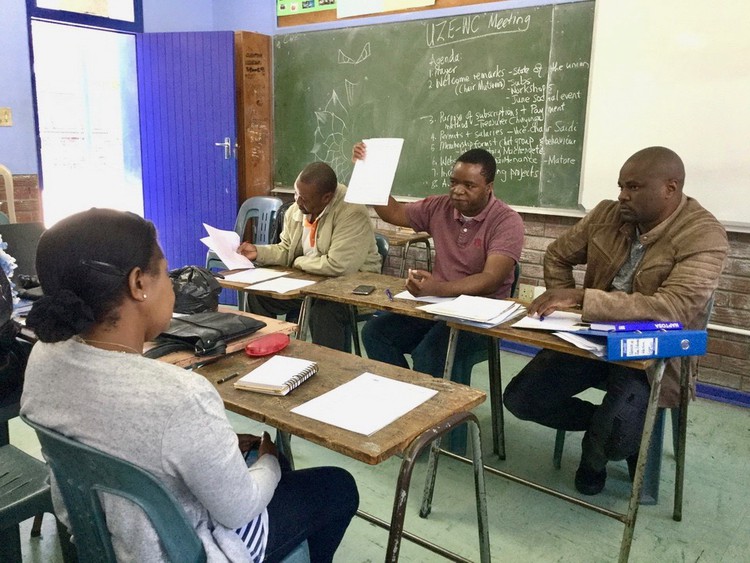
Jack Mutsvairo, chairperson of the Union of Zimbabwean Educators Western Cape, established in 2016, said the union has 50 members and a WhatsApp group of 200 teachers.

Mutsvairo said the union is irritated by the verification process. “If banks take less than a week to do it, why is the WCED taking months?”

“Some of the Zimbabwean teachers, who come to us claiming they haven’t been paid for between three to nine months, tell sad stories,” said Mutsvairo. Some, he said, have got into debt borrowing money for rent, food and their children’s school fees.

He said some teachers suffering from delays did not engage the union as they feared victimisation if they spoke out about being unpaid.

A man who teaches mathematics and physical science for grades 11 and 12, said he has been without a paycheck since January, awaiting his ZEP. On 3 August he collected his permit and submitted it to the department, but he was still not paid as the department awaited Home Affairs to verify the permit.

On Tuesday, Hammond told GroundUp his permit had been verified and his outstanding salary will be in his account by the end of the week.

Home Affairs did not respond to a request for comment.

Rwanda: Smart classroom project gathers momentum

James Karuhanga

The Ministry of Education has challenged secondary schools to fast-track a new model of smart classroom in a fresh bid to raise the quality of education.

The initiative, which seeks to equip schools with computers and access to internet, is premised on the belief that ICT is a tool which will transform the country’s education system through the digitalisation of academic material which will subsequently increase access.

The Minister for Education, Eugène Mutimura, recently said in a tweet that government had identified 166 schools to potentially take the lead in the implementation of the smart classroom project.

Irénée Ndayambaje, the Director General of Rwanda Education Board (REB), said that: “All those schools (that have been identified) have the requisite capacity and infrastructure to do it and are able to be role models to other schools”.

The Government has been encouraging schools to identify secure rooms where they can install computers and other ICT related infrastructure

Under the project, government plans to distribute 100 computers in each school. It targets 1,500 schools.

Ndayambaje said on Friday last week that ICT in education is not simply about students getting computer lessons but rather using the computers to expand their knowledge in the subjects they study.

So far, he said, 692 schools have smart classrooms.

“We are targeting 1,500 secondary schools. The remaining schools are yet to get either access to electricity and or do not have free rooms that can serve the purpose. We require two free rooms, with electricity, each with 50 chairs and quality desks or tables. And metal windows and doors to guarantee maximum security.”

Infrastructure, he said, is key to the success of the project.

“Not all schools in the country have electricity. Secondly, not all schools have enough rooms yet we need extra rooms for computers. Not until all these issues are solved shall we know when we can have it all set,” Ndayambaje said.

There’s optimism from government that by 2020 all public schools will be equipped with smart class rooms.

Edouard Uhagaze, the teacher in charge of studies at Lycée Notre-Dame de Cîteaux in Kigali, said the school launched a pilot phase last term.

“We are still undergoing a trial phase. The system for the programme has just been installed and teachers are being trained by a company sent by the Ministry of Education on how to use it,” he said, adding that; “By and large, it would be too early to talk about the gains right now but for sure the idea behind this project is very good because this is all about helping students learn easier using information technology”.

His school, he said, had already been using computers in its teaching processes and the new project is likely to add value.

Courses, which are interactive and multi-media based, will enable students to learn on their own and facilitate the teachers to prepare lessons.

The Government has already distributed POSITIVO Laptops – which have Microsoft Word and Windows, and teachers and students can surf the internet and research as well as access different content that comes with the laptops – to more than 500 schools across the country in addition to more than 250,000 XO Laptops to more than 1,500 primary schools.

The aim of smart classrooms is to incorporate ICT into various aspects of the country’s education system and bring a fundamental change in teaching and learning systems.

Smart classrooms are being equipped with computers connected to the internet with a screen projector, among others.

The aim is to bring about positive change both for teachers and learners as the latter get a wide range of resources while the former also teach using a wide range of resources other than using a single book.

The New Times.