More than 14,000 prospective students have registered for placement at an institution of higher learning using the Department’s Central Applications Clearing House (CACH) system.
Speaking to Inside Education on Friday, the director of the Department of Higher Education and Training’s (DHET) central application service, Joel Ramatshepe said 14,674 students registered since January 5.
“There are 14,674 students who have registered and 11,484 of those students had registered themselves and 3,190 used our call centre services,” said Ramatshepe.
Ramatshepe said he was pleased to see students were using the system and continued to urge those who had not applied at an institution of their choice to do so before the system closed at the end of February.
The government online application portal, which started in 2013, was designed for students seeking admission to an institution of higher learning. Students search the databases of institutions to find out where there are places available and which courses are still available.
Ramatshepe said students who met the relevant criteria and had not been offered a place or were looking for a place, could register with CACH, or: contact the toll-free number on 0800 356 635.
Students can also send an SMS of their full names and ID numbers to 49200.
Registration began on Friday, on January 5 and will continue until Wednesday, February 28.
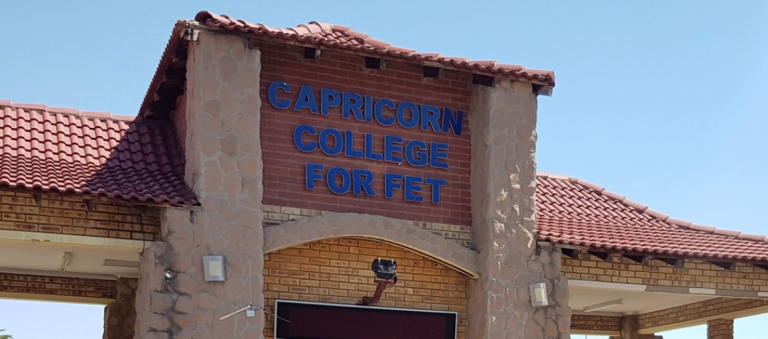
Several students were left injured and ferried to the nearby provincial hospitals when a stampede broke out at Capricorn TVET College in Polokwane, Limpopo, forcing management to suspend their ongoing registration indefinitely.
[BREAKING NEWS] Two prospective students have been taken to hospital after a stampede at the Capricorn TVET college in Polokwane in Limpopo- Hundreds of applicants have been queuing for admission for the 2018 academic year #sabcnews/ Pic: @WitnessTivapic.twitter.com/jMp6g3jqG8
According to eyewitnesses, the campus security personnel failed to control throngs of prospective students who pushed through the gates. It is believed students were queued since the early hours of Monday morning.
Reports say the registration queues stretch between 4 and 5kms with some students having slept outside the campus to be first in line. Gladys, one of the prospective students who spoke to SABC news, said since Monday the institution battled to deal with the applicants.
“Yesterday we started queuing from 6am and already at 8am the line was so long we felt demoralised. We have now been told we should report at Peter Mokaba stadium where registration would now be held,” she said.
Walk-in applications have been discouraged and prospective students were instead encouraged to register online. In 2012 a mother, Gloria Sekwena, was trampled to death during registration at the gates of the University of Johannesburg.
The Western Cape Education Department (WCED) is working feverishly to place learners in schools before schools re-open next week. Although the number of learners to be placed is considerably smaller compared to their Gauteng Education Department, officials at the province say the pressure is just as enormous.
WCED’s Paddy Attwell told Inside Education on Thursday morning, that they were working under considerable pressure to ensure they found places for over 11,000 learners. He said over the past five years they have experienced a huge spike of about 130,000 learners coming mainly from the Eastern Cape.
He said although they had their own data to determine how many schools were needed to cope with the numbers of learners from other provinces, the department did not have sufficient funds to build as many as they would like to. He said mobile classrooms only took six weeks to set up, making them a simpler and quicker solution.
“Building new schools is a long-term solution and what we are focusing on at the moment is to look at other short-term solutions such as the deployment of mobile classrooms,” said Attwell.
He said at the moment most “schools of choice” were full which is why they decided to install mobile classrooms, particularly in areas that experience rapid growth. Attwell said they spent R1.6 billion on building new schools and on the maintenance and expansion existing schools.
In a statement released this week, WCED said they were struggling to accommodate particularly learners in Grades 1 and 8. The department said since last year they placed 99% (1.1 million) of the learners needing a place, with 11,249 still waiting.
The department said their officials and schools planned well ahead to ensure every learner was placed, adding that each district had officials specifically assigned to help parents with placement.
The WCED said it would redeploy teachers in excess of requirements at certain schools to experiencing seeing rapid growth, where possible, depending on the teachers’ qualifications.
“We do encourage parents who plan to move to the Western Cape not to deregister their child/ children from their current schools before securing a place at a school in the Western Cape,” the statement read.
Management of the 26 member universities has been meeting regularly to avoid possible disruptions to the 2018 academic year. The most recent meeting was held on Monday.
The universities were strongly opposed to the idea of walk-in applications mainly to avert chaos and possible stampedes. In the meeting, however, universities decided to embrace the walk-ins as a reality of the time and adopted a more flexible approach to ensure the registration process continues smoothly.
It is projected that about 208,000 first-year students, will in the next three to four weeks, enter the system for the first time.
In a statement on Wednesday, Universities South Africa (USAf), the association representing the universities said it received feedback from a number of its member universities that had started to register students.
“In light of the broadly positive feedback received about the orderly manner in which registrations were progressing, it was decided that a more flexible approach would be adopted to address the question of walk-ins so as to ensure a successful registration period,” it said.
It was also decided that institutions that do not have vacant academic seats available would, within the context of the available resources and facilities, provide support facility to walk-in students so they can use and access the Central Application Clearing House (CACH). CACH is the Department of Higher Education and Training’s dedicated system that provides students with access to vacant academics seats across the university and TVET colleges.
According to USAF, it was also decided that universities with available vacancies could process walk-in applications “where there is a match between the candidates’ chosen field of study and the vacant seats”. Universities may also make available “their institutional online application systems” to enable students to register.
Each institution made a commitment to, where possible, inform students on the academic programmes that would still accept new students. Each university will also make its position known to the prospective students and to the public at large through various forms of communication.
The Gauteng Department of Education (GDE) is expected back in court on Thursday after the case brought against it by Hoërskool Overvaal in Vereeniging was postponed.
The school, which is an Afrikaans-medium of instruction school, brought an urgent application to the North Gauteng High Court last year to prevent the department from forcing it to accept an additional 55 pupils.
In its affidavit, the school claimed it was full and could not accommodate the 55 pupils.
However, the department rubbished those claims and said there was evidence which showed the school had enough space to accommodate these learners and students were denied based on their language preference.
The department said the school had 21 classrooms, and the capacity to accommodate 840 learners, but currently only accepted 621.
According to media reports, the department’s spokesperson Steve Mabona said the postponement was fair as a late affidavit had been filed by the school from other schools.
Mabona also said it was sad to see that schools would resort to legal action when the department had proof they had space.
“We want access to education for all. We offered to give them an educator, learner material and as such we don’t understand the resistance to accommodate other learners. All we asked for was dual-medium,” said Mabona.
Meanwhile, Paul Colditz, the CEO of the Federation of Governing Bodies of Southern African Schools (Fedsas), said he was in full support of the school.
Colditz said the department’s failure to build more schools forced school managers to admit learners even when they did not have the capacity.
“School managers can’t act irresponsibly by pushing up the numbers all the time. This will endanger the health and safety of the learners”, said Colditz.
Admitting learners beyond the school’s capacity amounts to an act of irresponsibility. This is what Paul Colditz, the chief executive officer of the Federation of Governing Bodies of Southern African Schools (Fedsas), said in an interview with Inside Education on Wednesday.
Colditz said while it was understandable that no learners be denied an opportunity to learn, the well-being and safety of learners should always come first. He said the current crisis of school shortages in Gauteng should be blamed on the province’s education department.
On Sunday, Gauteng MEC of education Panyaza Lesufi, said his department is working around the clock to accommodate over 31,000 grade 8 and grade 1 learners in schools across the province.
To add to the woes, several schools were damaged during recent storms. Lesufi admitted some of them would certainly not be ready when schools re-open this week.
“If you analyse the learner enrolment figures of schools in Gauteng and compared them with other schools elsewhere in the country, you will realise Gauteng schools enrol twice the number of other schools outside the province,” said Colditz.
He said on average most schools in Gauteng enrolled about 1000 learners, while the norm in other provinces was almost half the number.
“That in itself tells you there are not enough schools in the province,” he said.
Colditz said the Gauteng Department of Education (GDE) has a backlog of 200 schools that need to be built to deal with the increasing demand every year. He said every year the national Department of Basic Education publishes a document which provides all the relevant information for the various departments to use and plan properly.
Colditz expressed his support to the management of a Vereeniging based Hoërskool Overvaal after MEC Lesufi headed to Pretoria High Court to challenge their refusal to admit 55 learners. The management said the school reached its full capacity and was not able to accommodate any more learners. But Lesufi said the reason for refusing to admit the learners was based on the Afrikaans language. The case has since been postponed.
Colditz said the department’s failure to build more schools forced school managers to admit learners even when they did not have the capacity.
“School managers can’t act irresponsibly by pushing up the numbers all the time. This will endanger the health and safety of the learners”, said Colditz.
He said what made the situation even more untenable was that the department instructed schools without any proper investigation or communication.
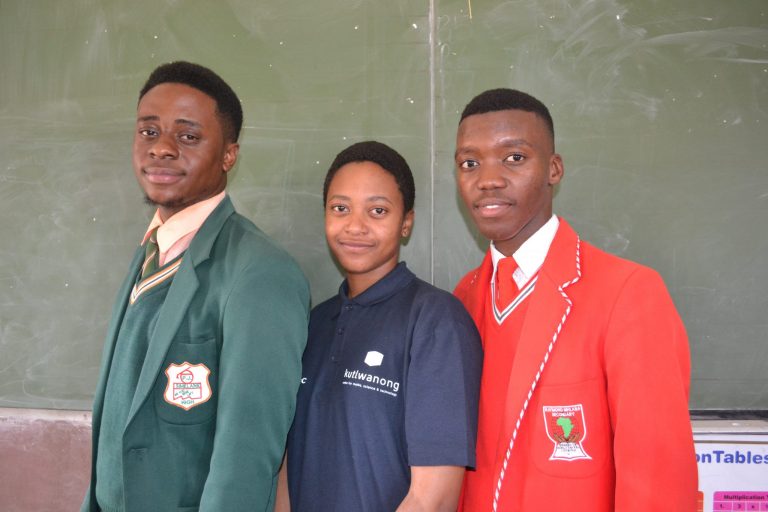
A Biblical adage that a man’s gift makes room for him and brings him before great men, proved to be true for some of the alumni from Kutlwanong Maths, Science and Technology Centre in Soweto who excelled in their 2017 matric exams.
They were honoured by the Minister of Education Angie Motshekga and Gauteng Education MEC Panyaza Lesufi.
Siyanda Pikwa (17) from Raymond Mahlaba Secondary School in Tshepisong was among the top learners recognised by Motshekga for his outstanding results nationally in Quantile 2. In Physical Sciences he obtained 100%, Mathematics 99%, Accounting 98%, Life Sciences 97%, IsiXhosa 90%, Life Orientation 89% and English First Language 83%.
“I did not expect to be recognised nationally. I was lost for words when I received the call from the Department of Education on Sunday. But then when I dropped the phoned, it sunk in, that I made it to the top nationally. I was picked up from home with a shuttle to Holiday Inn in Sandton. We had a buffet and breakfast with the Minister. It was a great honour to be under the same room with the Minister and the Deputy Minister. The results were announced on national TV. Lots of people saw me on TV. I received WhatsApp messages and phone calls even from those that I do not remember in Eastern Cape. My family is very proud of me,” said Pikwa.
He will be studying towards a degree in mechanical engineering at Wits University.
“I like working with machines and mechanical engineering deals with building, designing and maintenance of machines and engines,” said Pikwa.
David Sithole (18) from P.J. Simelane Secondary School in Dobsonville was honoured by Lesufi. Sithole obtained 100% in Physics and Accounting, 98% in Maths, 89% in Economics 85% in English, 84% in Life Orientation and 67% in IsiZulu.
“I studied and attended extra classes at school and Kutlwanong. I was honoured by the MEC at provincial level. He was shocked that I obtained 100% in Physics and Accounting. I cannot believe that I made it. The feeling is new. I was expecting this for accounting but physics I wasn’t sure,” said Sithole from Bram Fischerville.
He will be studying towards a degree in computer engineering at the University of Pretoria.
Although Itumeleng Leballo (18) from Bram Fischerville is among top achievers on the provincial level, she could not get an opportunity to receive credit from Lesufi. Leballo obtained 100% in Physical Sciences, 95 % in Life Orientation, 87% in Mathematics and Life Sciences, 86% in English First Language, 84% in Geography and 78% in Setswana.
Leballo from Kgatelopele Secondary will be studying towards BSc (Computer Science) at Wits University.
“I am happy that I got accepted at Wits University. I received the acceptance notification this morning before I got my results. I love computers. The whole concept about computer science is really interesting because you get to do programming, coding, software engineer and you get to develop something. I want to invent something great that can change this country because the world is moving really fast and I feel that South Africa is really behind with technology. I am hoping that my computer skills will help with that.”
Five top learners from Bhukulani Secondary School in Zola, Soweto who scored distinctions in their matric exams are seeking financial aid for their studies.
Babalo Gcobani 18, and his peers aged 17, Linda Zungu, Selby Tsatsa, Noluthando Kumalo and Sphiwo Maseko applied for financial aid from different organisations, but none have responded to their request.
Babalo Gcobani 18, obtained six distinctions and one B. Source: Vicky Abraham
Kumalo is the highest achiever at Bhukulani Secondary School and scored 97% in Physical Sciences, 91% in Geography, 89% in Life Sciences, 88% in Life Orientation, 86% in English, Maths 84% and 70% IsiZulu.
“I am still deciding whether I should study computer science or actuarial science. I want to study at University of Cape Town (UCT), but I have not been accepted. I applied to five organisations for bursaries and I haven’t received sponsorship. I feel unsure about my future, but I have hope that I will get bursaries from the organisations that I have applied to,” said Kumalo.
Gcobani obtained 91% in Physics, 90% in Life Orientation, 86% Geography, 85% IsiXhosa, 82% Life Sciences and 77% in Maths. He wants to study medicine at UCT.
“I am anxious because I haven’t received any offers from universities that I have applied to, despite my good marks. I don’t have funds because there are not many organisations that fund first-year medical students. Those who are willing to sponsor, they require conditional acceptance which I did not get from any of the five Universities that I applied to. My mother will not be able to pay for my fees. I will be happy to receive sponsorship from someone who will be willing to assist,” said Gcobani.
Zungu scooped 98% in Life Orientation, Maths 85%, Physics 82%, Geography 81%, Life Sciences 77%, IsiZulu 73% and English 72%.
Sphiwo Maseko (17) obtained five distinctions. Source: Vicky Abraham
“I want to study BSc computer science with applied mathematics at UCT. I don’t have funds and I really need funds so much. I did apply for funding, but I have not yet received any feedback. I live with my mother and we are not really well-off,” said Zungu.
Tsatsa obtained 99% in Maths, 89% in Physics, 87% in Life Orientation, 86% in accounting, 82% in IsiXhosa, 75% in English and 69% in Geography.
“I have been accepted at Wits University to study actuarial science. I love maths. It is my passion,” said Tsatsa.
Tsatsa also hopes that possible funders will come to his aid.
Sphiwo Maseko obtained 95% in Life Orientation, 90% in Economics, 87% in Accounting, 86% in Business studies and English, 73% in IsiZulu and 69% in Mathematics.
“I am planning to study economics and econometrics at the University of Johannesburg (UJ). I am conditionally accepted at UJ. I have heard that it is one of the best universities in the financial and economics field,” said Maseko.
Linda Zungu 17, scored four distinctions. Source: Vicky AbrahamSelby Tsatsa 17, scooped five distinctions. Source: Vicky Abraham
The management of the country’s 26 universities is working diligently to assist learners who qualify for financial assistance to ensure no one is left out before the academic year kicks off next month.
This is what transpired yesterday at a meeting between the department of higher education and training (DHET), National Student Financial Aid Scheme (NSFAS) and Universities South Africa (USAf). The troika is very crucial in ensuring the coordination of all plans and systems related to the implementation of the fee-free higher education
Among the prominent figures who attended the meeting were NSFAS’s chairperson, Sizwe Nxasana, DHET’s Diane Parker and USAF’s Professor Ahmed Bawa.
According to Bawa, the meeting was fruitful as it helped further clarify the role of each player to make sure every qualifying student receives financial support to realise his or her dream of studying at a university of their choice.
“We discussed in greater detail every aspect related to the funding issue so that we can guide and advise students and the parents how to go about registering without any glitches,” said Bawa.
He said their main priority was to assist students who have applied to universities but have not applied for financial aid.
For instance, NSFAS has revised its old family earnings threshold of R122,000 to R350,000 and it is crucial that this information is made readily available. Students who qualify will have to contact the Financial Aid Office at their university and ask to be considered for an NSFAS bursary.
The other crucial bit of information relates to students who failed to apply to a university. They will have to apply online or apply via the DHET’s Central Application Clearing House (CACH) system which would allow DHET, universities and TVET colleges to work jointly to place them across the system.
Bawa said even though he cannot predict the future with some measure of accuracy, he is optimistic all will go according to plan. “It is not like there is a looming crisis except the attempt to politicise the issue”, said Bawa.
He said the Economic Freedom Fighters’ (EFF) call for students to register in person at various tertiary institutions caused them some anxiety. However, Bawa applauded the organisation “for having identified that community of students” who are now being prioritised.
Students from poor and working class families with combined income of up to R350 000 per annum are not expected to pay any upfront registration fee at the country’s tertiary institutions as from this year, the Department of Higher Education clarified on Tuesday.
In a statement the department said there would be no upfront registration payment at TVET Colleges and universities for students who qualify for NSFAS funding. Students who do not qualify for NSFAS funding will be expected to pay upfront registration as has been the norm.
This is in line with the free tertiary education plan announced by President Jacob Zuma last December.
According to the department’s estimate, those expected to pay upfront registration fees currently make up to 55% of the country’s student population and come from high income families who can afford to pay for their tertiary education. It is also estimated that these high income households make up less than 3% of the country’s population.
The new free tertiary education plan is aimed at changing the current student population demographics at the country’s tertiary instutions by ensuring that over 90% of the students from poor and working class families have access to higher education . These are students from families who make the 55% of the country population who, according to a Statistics South Africa 2017 report, live in poverty.