
Staff Reporter
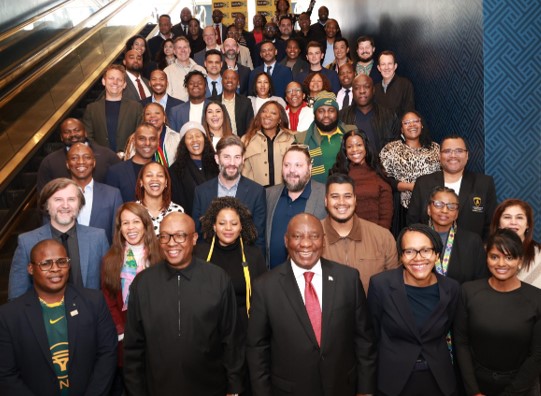
Students who joined President Cyril Ramaphosa’s Silicon Valley delegation have called for AI to be taught in schools and across university disciplines, and for better research infrastructure to put their work into practice.
The 15 to 21 November working visit was intended to inform how South Africa develops and adopts AI, attract investment and build partnerships with technology companies and research institutions.
The delegation included government officials, academics, entrepreneurs and students. Its programme covered robotics, cloud computing and the use of AI across various sectors.
In a closing address in San Jose on Friday, Ramaphosa said South Africa would develop a national AI action plan within 90 days. He said it would identify ways to use AI in public services such as education and healthcare, attract investment in AI infrastructure and expand access to advanced models, computing resources and data for universities, researchers and start-ups.
He said he intended to outline the plan’s main elements in his State of the Nation Address in February.
Mahlatse Moretsele, a data science student at Sol Plaatje University, said at a briefing at the end of the visit that seeing students at Sacramento State University turn ideas into projects with commercial potential showed what South African students could do with their own work. She called for AI education to extend beyond technology qualifications and for school learners to be introduced to it.
Buhle Matiwane, a Master of Commerce student in information systems at the University of Fort Hare, said the visit had informed her research into how universities could integrate AI into their curricula to close gaps between what students learn and what employers need.
“My take home is additional knowledge, a new perspective, and opportunities to collaborate,” she said.
Sicelo Vuyo Bholo, an electrical engineering N6 student at Sedibeng TVET College, said conversations with university students and doctoral candidates had strengthened his confidence in the quality of South African institutions.
Nandi Shandu, an application development graduate from Durban University of Technology, said sessions at Stanford University, Cisco and Microsoft had changed how she viewed AI’s role in software development.
“I realised that AI and AI agents aren’t here to replace the software engineering and system design foundations that I’ve worked so hard to build. They are here to amplify them,” she said.
Alexander Sittmann, a fourth-year medical student and master’s student in bioinformatics at the University of Cape Town, said access to infrastructure was a major difference between South African researchers and their peers at leading US universities. AI could help researchers with limited coding experience analyse large datasets, he said, but getting those findings into clinical practice remained a challenge, particularly in rural areas.
“The gap lies in our implementation, and that’s especially prevalent in the healthcare sector,” he said.
University of Johannesburg executive dean Professor Tankiso Moloi said the visit had helped the delegation identify gaps in South Africa’s AI capabilities and consider how research could help close them.
Pelonomi Moiloa, chief executive and co-founder of Lelapa AI, which develops language models for African languages, pointed to commitments to increase venture capital investment in local businesses and improve start-ups’ access to computing resources. She said young companies also needed contracts and a domestic market for their services.
Scientist and entrepreneur Siyabulela Xuza said the private sector was ready to contribute.
“Business is ready. If we act now, South Africa won’t be catching up. We will be ahead, with no South African being left behind,” Xuza said.
INSIDE EDUCATION