

By Lebone Rodah Mosima
The Gauteng Department of Education (GDE) has registered 203,794 candidates for the 2026 National Senior Certificate (NSC) examinations, an increase of 11,049 from last year.
The cohort comprises 152,527 full-time candidates and 51,267 part-time and repeater candidates. The examinations will run from October 13 to November 26.
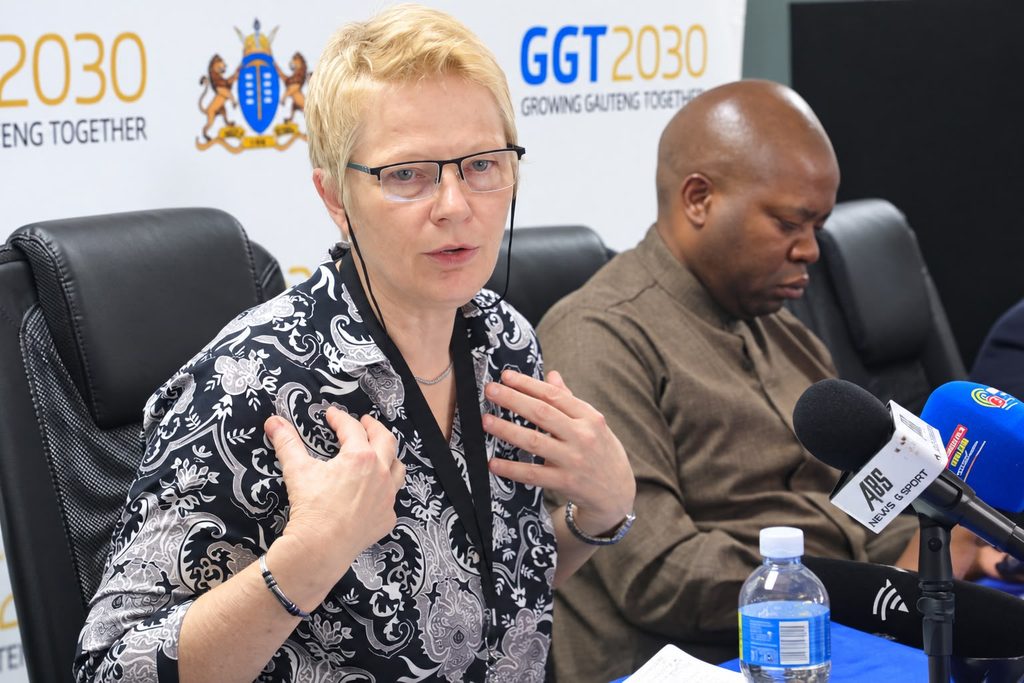
Gauteng Education MEC Lebogang Maile briefed the media on Monday on the province’s state of readiness, saying the 2026 cohort was the first in Gauteng’s history to exceed 200,000 candidates.
“This is a reflection of both the quantitative increase in the population of Gauteng, and by extension its learner population, as well as a reflection of the trust in the qualitative strength of the education system in the province,” Maile said.
A total of 192,745 candidates registered for the examinations in 2025.
Maile said all three categories of candidates — full-time, part-time and repeaters — had increased this year.
The examinations will cover 77 subjects, comprising 155 question papers. While full-time candidates are required to write seven subjects, almost 20,000 will also write an eighth subject.
Examinations will be administered across all 12 official South African languages, as well as foreign languages at the applicable levels.
English recorded the highest enrolments at Home Language and First Additional Language levels, with 54,163 and 98,350 candidates, respectively. This was followed by isiZulu at Home Language level, with 31,940 candidates, and Afrikaans at First Additional Language level, with 44,879.
Maile said 70.7% of full-time candidates had registered for Mathematical Literacy, compared with 29.3% for Mathematics.
The examinations will be written at 1,065 registered and audited centres across the province.
Enrolments range from two to 545 candidates at full-time centres and from nine to 1,513 at part-time centres.
Maile said the department had worked with all 15 education districts and schools to ensure operational readiness.
School principals will serve as chief invigilators, while additional support will be provided to high-risk centres, including those with large enrolments, newly established centres and those that experienced examination challenges in previous years.
Private chief invigilators and resident monitors have been appointed and trained to strengthen oversight at these centres.
The department will print, package and distribute an estimated 2.7 million question papers, comprising 76.5 million print images, to 16 storage points each week. The papers will then be distributed daily to examination centres through 75 dedicated distribution points.
Approximately 1,700 monitors, including provincial, district and resident monitors, will oversee the examination process.
Their responsibilities include checking examination systems and centre readiness, inspecting secure storage facilities, verifying key management and the chronological storage of question papers, and auditing electronic security measures.
The department has also audited school-based assessments, practical assessment tasks and teacher files.
“Our target remains 100% monitoring coverage, exceeding the national requirement of 70%,” Maile said.
Preparations for marking are at an advanced stage, with 27 marking centres identified and audited. The appointment of 14,800 marking personnel is under way.
Maile said systems and resources had been put in place to process examination scripts and capture marks ahead of the release of the 2026 results on January 12, 2027.
Security and examination integrity
The department has introduced measures to prevent examination irregularities, including a pledge-signing ceremony held at schools across the province on October 9.
Candidates were briefed on examination rules, the code of conduct and the sanctions for non-compliance.
Maile said penalties for disruptive or dishonest behaviour could include the nullification of results, delays in obtaining a matric qualification and exclusion from up to three future examination cycles, depending on the severity of the offence.
Security measures across the examination process include secure printing facilities, audited storage and distribution points, armed security escorts, access controls, surveillance systems and double-locking mechanisms.
“All district storage facilities and distribution points have been audited and strengthened security arrangements are in place for the duration of the examination,” he said.
The department will also use real-time reporting systems and security scanners at examination room entrances to detect concealed electronic devices.
Maile said the scanners were intended to identify sophisticated cheating devices, including smart glasses, spy pens with hidden recording technology and micro-earpieces, rather than invade learners’ privacy.
“With the rise of ‘cheat-tech’, students are increasingly using highly sophisticated gadgets to smuggle information into examination centres,” he said.
“Super security scanners help by detecting hidden wireless signals, adding a necessary layer to ensuring the integrity of the examination process.”
The department will also work with police and other law enforcement agencies where necessary to prevent disruptions during the examination period.
Maile said measures would be taken to prevent examination paper leaks, adding that question papers were kept in guarded facilities.
Academic support for candidates
Maile said the department had provided additional academic support throughout the year through programmes targeting learners who needed assistance, as well as those seeking to improve their results.
The Secondary School Improvement Programme (SSIP), managed in partnership with the Sci-Bono Discovery Centre, supports priority and underperforming high schools from Grades 8 to 12, with intensive assistance for matric candidates.
The programme focuses on gateway subjects, including Mathematics, Mathematical Literacy, Physical Sciences, Life Sciences, Accounting, English First Additional Language, Economics, Business Studies, History and Geography.
It provides free Saturday classes, holiday lessons, examination preparation camps, tutoring, learning materials, catering and transport assistance.
Maile said digital learning resources had also increased candidates’ access to subject-based learning and assessment activities.
Special monitoring teams track attendance, teaching quality and pre- and post-test results to identify and address learning gaps.
He said SSIP had helped learners affected by disruptions during the year, including service delivery protests and interruptions to municipal services.
The department also runs a High Flyer Programme for top-performing Grade 12 learners, offering specialised tuition and revision camps aimed at improving distinction rates and bachelor-level passes.
The programme focuses on subjects such as Mathematics, Physical Sciences, Accounting and Business Studies, providing specialised notes, structured learning materials and problem-solving sessions led by subject advisers and experienced teachers.
Maile said the programme was designed to meet the needs of advanced learners who might not be sufficiently challenged by the pace of conventional classroom teaching.
The department’s Just-in-Time Programme provides short-term professional development for teachers ahead of specific curriculum requirements. It combines standardised lesson plans, learning materials and classroom coaching.
Candidates will also have access to daily revision opportunities ahead of examination papers.
Gauteng targets further improvement
Gauteng recorded its highest-ever matric pass rate of 89.1% in 2025, continuing a five-year trend of annual improvement since 2021.
The province ranked third nationally, producing 67,861 bachelor passes, equivalent to 48.15% of candidates who wrote the examinations.
All 15 districts achieved pass rates above 83%.
Johannesburg West was the top-performing district, with a pass rate of 96.2%, while Gauteng East recorded the lowest rate at 83.7%. Independent schools in the province achieved a pass rate of 94.82%.
Maile said the department was confident that the Class of 2026 would continue the upward trajectory, given the support provided throughout the year and during the examination period.
He called on parents, guardians and communities to help candidates prepare by providing suitable study environments, limiting household chores and ensuring learners were well-rested.
Through its “It Takes a Village to Raise a Child” programme, the department has emphasised the role of families and communities in supporting learners.
Maile urged communities not to block access roads or school gates during the examination period, warning that candidates who missed papers because of disruptions would have to write them in the June 2027 examinations.
Such delays could affect their transition to higher education and training.
He also advised candidates to limit their use of social media during the examination period, saying it could affect their mental and emotional well-being.
“The Department cannot over-emphasise the importance of candidates maintaining personal integrity during this process,” he said.
“Cheating has no place in our examination system. We call on every candidate to uphold the values of integrity, honesty and hard work espoused in the NSC Pledge that all candidates have already signed.”
Acting Gauteng education head of department Albert Chanee said the department had established policies and guidelines to prevent political campaigning from disrupting schools during the election period.
“There is an established protocol that there is no political campaigning, and that no political officer can come into a school to address the staff unless it is on community matters,” Chanee said.
He said the protocol had been in place for a long time and had not caused problems in previous years.

INSIDE EDUCATION