
By Thapelo Molefe
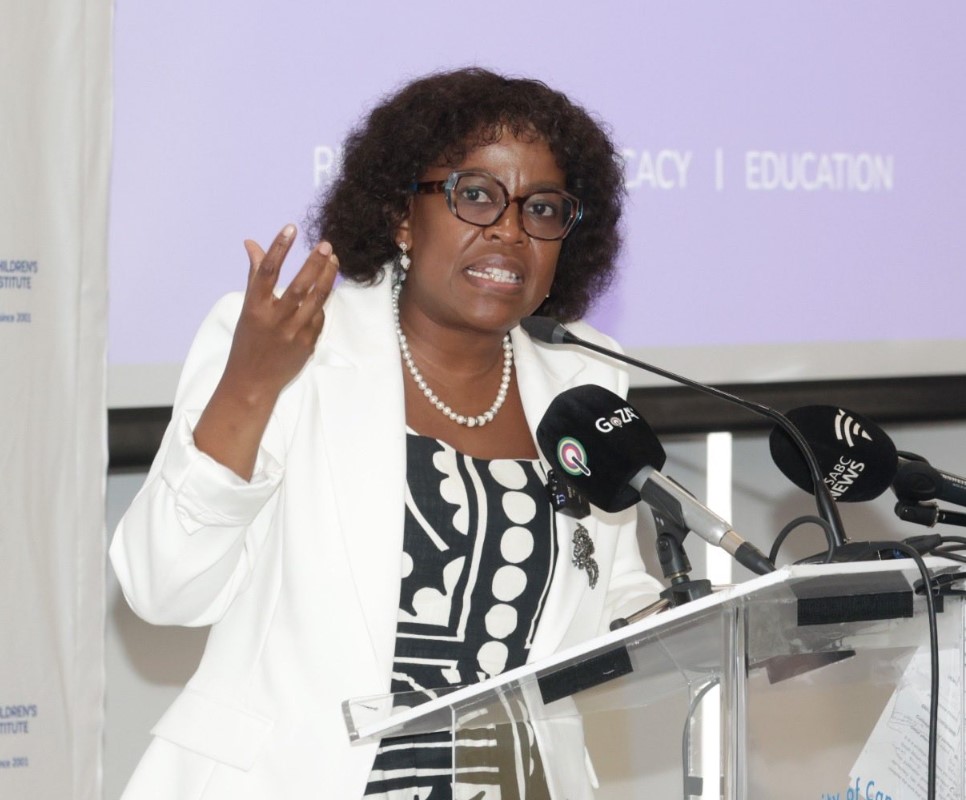
Minister in the Presidency Maropene Ramokgopa has called for stronger coordination across government and society to address child poverty, malnutrition, violence and inequality, warning that access to public services does not necessarily translate into improved outcomes for children.
Delivering the keynote address at the launch of the 2026 South African Child Gauge at the University of Cape Town on Tuesday evening, Ramokgopa said government needed to move beyond measuring the number of children reached by programmes and focus on whether interventions were making a measurable difference in their lives.
“The Child Gauge report reminds us that access to services alone does not necessarily translate into positive outcome,” she said.
“A child may attend school, but still not acquire foundational literacy skills. A health care visit may not result in the early identification of developmental challenges. Social assistance may provide essential support to families while still falling short of meeting their nutritional needs.”
The report, which monitors the situation of children in South Africa, highlights persistent challenges affecting their well-being and calls for evidence-based interventions to improve their living conditions.
Ramokgopa said the findings should inform government planning, budgeting and decision-making, adding that she would explore bringing the report before Cabinet or one of its committees for consideration.
She said government had introduced a stronger focus on evidence-based interventions and measuring the impact of public spending, rather than relying on reports of activities and money spent.
“We must also ask whether those services are improving children’s lives in a meaningful and measurable way,” she said.
“Even if you say that, no, we spent this much, we’re not giving it to you, because it must be measurable.”
Ramokgopa said South Africa continued to face unacceptably high levels of child poverty, with approximately one in every four children under the age of five affected by stunting, which can have lifelong consequences for their health, learning and productivity.
She said an interministerial committee had been established to address the country’s developmental challenges, with the Department of Basic Education expected to work with the Department of Health to develop solutions to child stunting.
The minister said interventions needed to address maternal health and nutrition, food security and support during infancy, while also ensuring that adolescents had access to quality education, healthcare, mental health support and protection from violence.
She emphasised the importance of the first 1,000 days of a child’s life, saying early childhood development remained central to government’s strategy under the 2024-2029 Medium-Term Development Plan.
Ramokgopa also acknowledged the burden placed on caregivers, particularly women, who often have to choose between employment and caring for their children.
Sharing her personal experience, she said she had once stopped working for three years to care for her premature child.
“I had to choose between looking after a child who’s premature and continuing with my work. And I couldn’t do both. So I had to stop working for three years so that my child can now be well enough,” she said.
She said reliable public services, adequate income support, better healthcare and stronger family support systems were necessary to support both children and their caregivers.
Ramokgopa further raised concerns about inequalities affecting children based on where they live, their families’ financial circumstances and the quality of public services available to them.
She said children with disabilities, those in rural communities and those without official documentation often faced barriers that were not adequately reflected in national statistics.
The minister called for better coordination between government departments and spheres of government, saying families should not have to navigate fragmented systems to access healthcare, education, social assistance and protection services.
She also highlighted the need to improve the way government assesses schools, saying performance should not be measured only through matric pass rates but should also consider the quality of investment and the learning outcomes achieved by children.
“It’s not enough to just ask how many children are reached or have reached certain programmes, or are reached by certain programmes and interventions,” she said.
Ramokgopa said the Child Gauge provided government with district-level data that could help identify gaps and direct resources to communities where children were being left behind.
She also called for children’s participation in decisions affecting their lives, saying their experiences and those of their caregivers could help strengthen public policy and improve service delivery.
The minister praised the Children’s Institute and its partners for producing the Child Gauge, which has been published since 2001, and said government intended to use the research to assess the impact of its policies and programmes.
She said infrastructure development, economic planning and public spending should also be assessed according to their impact on children’s rights and well-being.
“The report challenges all stakeholders, including government, civil society, researchers and development partners to use evidence to drive practical improvement in children’s life,” Ramokgopa said.
INSIDE EDUCATION